Big Sky vs Whitefish — Which Montana Mountain Town Is Right for You?
By Ashley Inglis, Real Estate Advisor & Broker, MT Lux Real Estate Montana has two mountain towns that consistently top the list for luxury buyers: Big Sky and Whitefish. Both offe
By Ashley Inglis, Real Estate Advisor & Broker, MT Lux Real Estate
Montana has two mountain towns that consistently top the list for luxury buyers: Big Sky and Whitefish. Both offer world-class skiing, jaw-dropping scenery, and access to some of the most iconic landscapes in the American West. But they’re fundamentally different places — different energy, different community, different real estate dynamics.
If you’re weighing one against the other, the decision isn’t really about which town is “better.” It’s about which lifestyle fits yours. I’ve helped buyers navigate both markets, and the right choice almost always comes down to what you actually want your daily life (or your vacation) to look and feel like.
Here’s the honest breakdown.
Two Towns, Two Personalities
Big Sky — The Resort
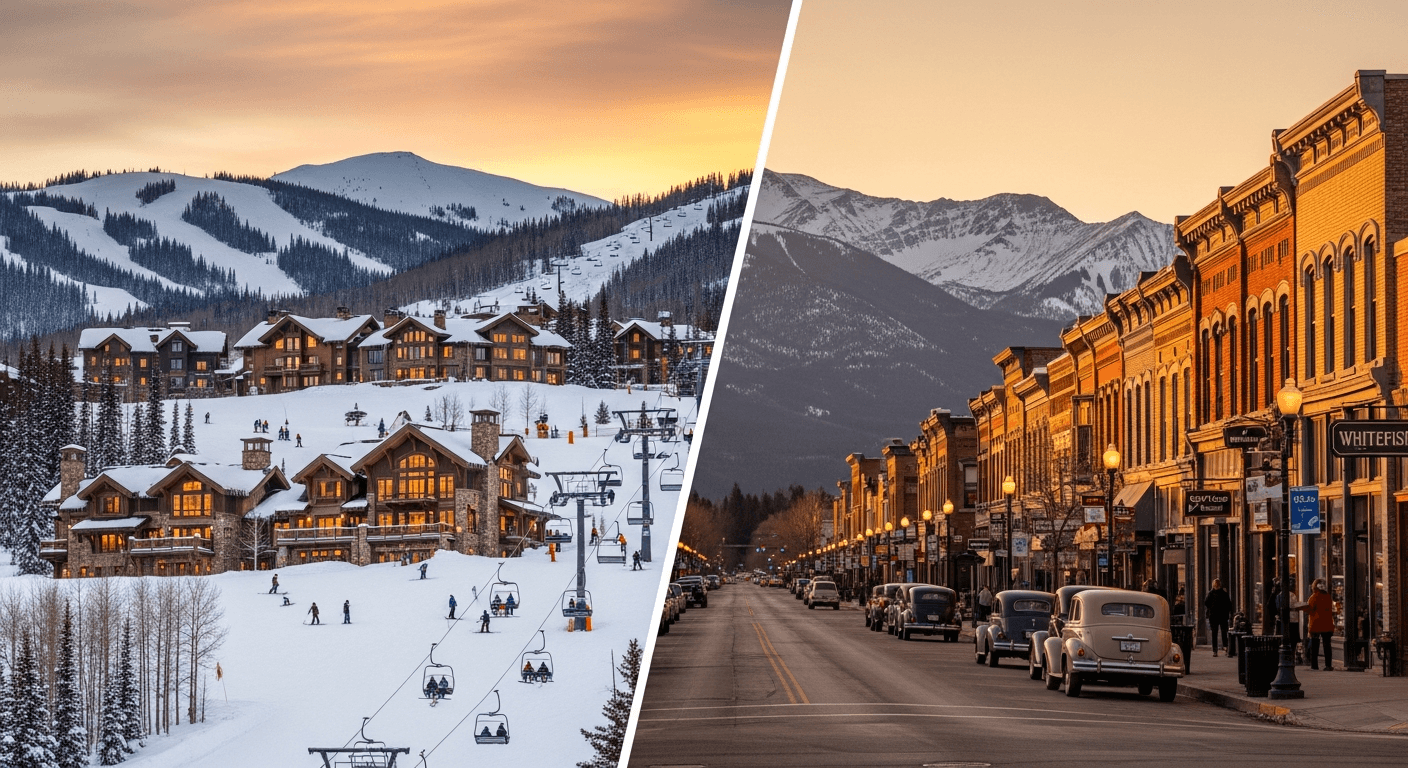
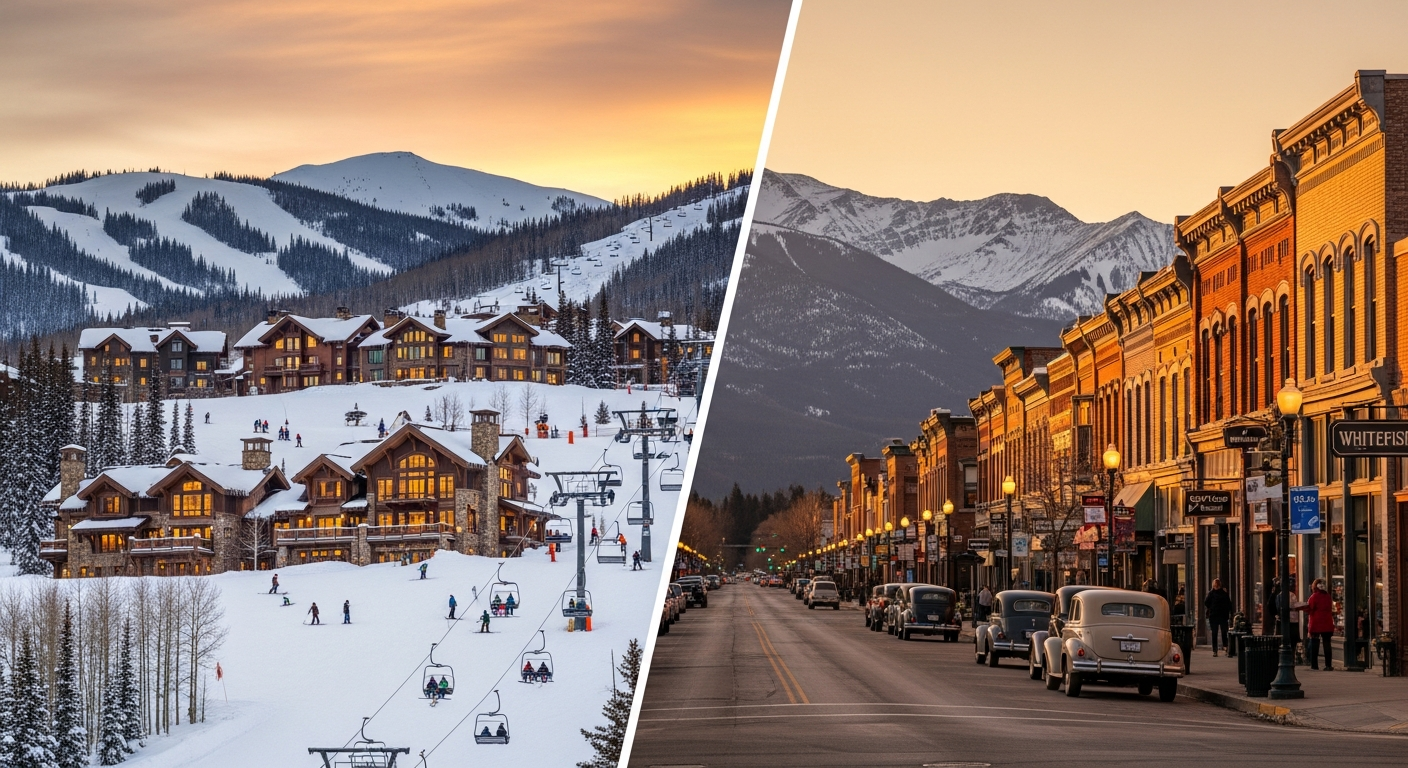
Big Sky is Montana’s premier destination resort community. It was built around skiing — specifically, Big Sky Resort and the Yellowstone Club — and that identity shapes everything about the town. The infrastructure, the dining, the real estate: it all orbits around the mountain.
Big Sky sits in the Madison Range of the Northern Rockies, roughly 45 minutes south of Bozeman and an hour north of Yellowstone National Park’s west entrance. The scenery is dramatic — Lone Mountain dominates the skyline at 11,166 feet, and the Spanish Peaks provide a sawtooth backdrop that looks like it was designed by a Hollywood set department.
The town itself is spread out. There’s no traditional “downtown” in the way most people picture a mountain town. Instead, Big Sky is organized around a few commercial nodes — the Town Center, the Mountain Village, and Meadow Village — connected by Highway 64. It’s a driving community, not a walking one.
What Big Sky does exceptionally well: scale. The ski terrain is massive (5,800+ skiable acres), the properties tend to be newer and larger, and the proximity to Yellowstone gives it an adventure-tourism cachet that few places in North America can match.
Whitefish — The Town
Whitefish is a real town that happens to have a ski resort. That distinction matters more than most people realize until they’ve spent time in both places.
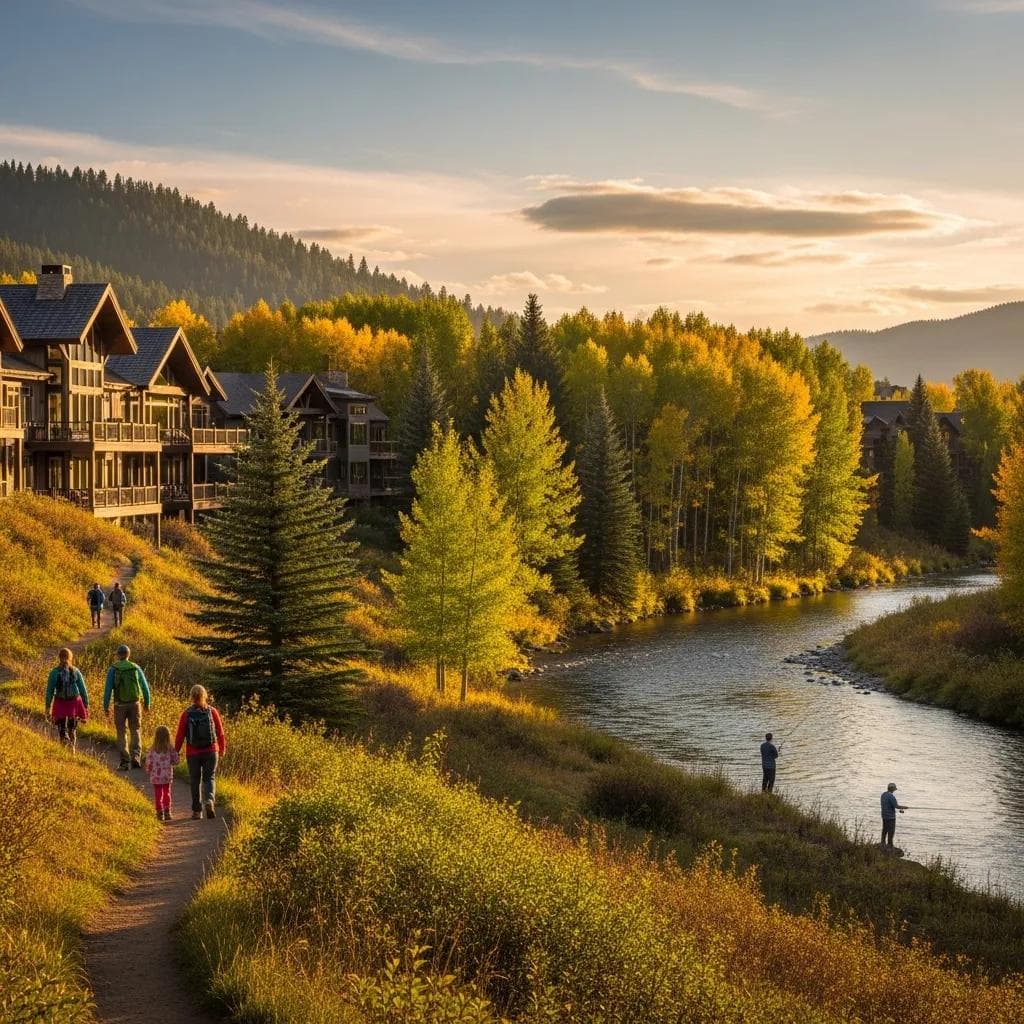
Central Avenue — Whitefish’s main street — is a walkable, year-round downtown with locally owned restaurants, galleries, breweries, and shops that serve residents, not just tourists. The Great Northern Bar is where powder days end. Third Street Market is where locals grab organic produce. The Whitefish River walking paths connect downtown to nature in a way that most resort towns can’t replicate.
Whitefish Mountain Resort (still called “The Big” by anyone who’s lived here longer than five years) sits ten minutes from town. Glacier National Park’s west entrance is thirty minutes north. Whitefish Lake — some of the most pristine freshwater in the Lower 48 — is right at the town’s edge.
The community here is year-round. Teachers, nurses, contractors, business owners, artists — they live alongside second-home owners and retirees. That social fabric gives Whitefish a texture and authenticity that purely resort-driven towns struggle to match.
Side-by-Side: What Matters Most
Skiing
Big Sky Resort is the headliner. With 5,800 skiable acres, 4,350 feet of vertical drop, and an average of 400 inches of annual snowfall, it’s one of the largest ski areas in North America. Lift lines are shorter than you’d expect for a resort this size, partly because of the sheer acreage and partly because Big Sky’s visitor count hasn’t caught up to its capacity. The terrain ranges from gentle groomers to genuinely expert-only chutes off Lone Mountain’s summit.
Whitefish Mountain Resort is smaller — about 3,000 skiable acres and 2,353 feet of vertical — but it punches above its weight. The tree skiing is some of the best in the Northern Rockies, the snow quality is consistently excellent, and the vibe is relaxed. No one’s trying to impress anyone. You’ll share a chairlift with a retired surgeon and a ski patroller and a 12-year-old local ripper, and the conversation will be the same.
If raw terrain size and vertical are your priorities, Big Sky wins. If you want a ski mountain with soul and a town at the bottom of it, Whitefish is hard to beat.
Downtown and Town Culture
This is where the gap widens. Whitefish has a genuine, walkable downtown with year-round energy. Central Avenue has enough restaurants, bars, and shops to keep you engaged without feeling overwhelmed. The farmers market runs all summer. Live music happens in venues that don’t feel manufactured for tourists.
Big Sky’s Town Center has improved significantly in recent years — new restaurants, a plaza, better retail — but it still feels like a planned commercial district rather than an organic downtown. It’s pleasant, it’s convenient, and it serves the community well. But if you’re coming from a place where you loved having a walkable main street and coffee shops and bookstores, Whitefish is the answer.
Dining and Nightlife
Both towns have strong dining scenes relative to their size.
Big Sky offers resort-caliber dining, particularly at the higher end. Lone Peak Brewery is the go-to casual spot, Horn & Cantle at Montage Big Sky brings fine dining to the mountain, and the Yellowstone Club has private dining options that rival any city restaurant.
Whitefish’s dining scene is broader and more eclectic. Café Kandahar is a perennial standout for fine dining with a Montana accent. Tupelo Grille does Southern-meets-mountain cuisine. Wasabi is better sushi than a town of 8,000 people has any right to claim. The bar scene is lively — Whitefish has the kind of nightlife where you end up staying out later than you planned because someone interesting sat down next to you.
Year-Round Activities
Big Sky: Yellowstone National Park (less than an hour), fly fishing on the Gallatin River (legendary), mountain biking at Big Sky Resort, hiking in the Lee Metcalf Wilderness, golf at the Big Sky Resort Golf Course. Summer is spectacular but quieter — the shoulder seasons can feel thin.
Whitefish: Glacier National Park (30 minutes to the west entrance), Whitefish Lake for boating and swimming all summer, mountain biking on the Whitefish Trail system (over 50 miles of purpose-built singletrack), Nordic skiing at the Glacier Nordic Center, fly fishing on the Flathead and Whitefish Rivers, golfing at Whitefish Lake Golf Club. The town stays active year-round — there’s no “dead season” the way some resort communities experience in spring and fall.
Accessibility and Airports
Big Sky is served by Bozeman Yellowstone International Airport (BZN), roughly a 50-minute drive. BZN has grown rapidly and now offers nonstop service to most major hubs, including direct flights from Dallas, Chicago, Denver, Seattle, Los Angeles, and Minneapolis. It’s become one of the fastest-growing airports in the country.
Whitefish is served by Glacier Park International Airport (FCA) in Kalispell, just 15 minutes from downtown Whitefish. FCA has expanded its route network significantly — nonstop flights now connect to Denver, Minneapolis, Seattle, Salt Lake City, Dallas, Chicago, and several others. The convenience of a 15-minute airport drive versus a 50-minute one is something second-home owners notice every single trip.
Whitefish also has Amtrak service via the Empire Builder line — a legitimate and scenic option that connects to Seattle and Chicago.
Community Feel
This is the most subjective comparison, and arguably the most important one.
Big Sky feels like a resort. That’s not a criticism — it’s a beautiful, well-designed resort community, and the people who live there love it. But the social infrastructure is thinner. The year-round population is smaller, and much of the community’s energy is seasonal. If you’re buying a vacation home and your priority is access to world-class skiing and Yellowstone, Big Sky delivers at the highest level.
Whitefish feels like a hometown. The year-round population is larger and more diverse in its occupations and backgrounds. There are school events, community theater, a functioning public library with programming, volunteer fire departments, and neighborhood block parties. You can build a social life here that doesn’t revolve around the resort.
Looking for specific properties in either Big Sky or Whitefish? Contact Ashley Inglis at (406) 880-5985 for a private showing or off-market listings. Whether you’re narrowing your search between the two markets or ready to tour homes, I can walk you through what’s available — including inventory that hasn’t hit the MLS.
Real Estate Market Comparison
Ready to see what’s available? Contact Ashley Inglis at (406) 880-5985 for a private showing or off-market listings.
Here’s where the numbers tell the story. Both markets are strong, but the character of the inventory and the price structure differ in important ways.
| Category | Big Sky | Whitefish |
|—|—|—|
| Median Home Price | $1.8M – $2.5M | $1.0M – $1.5M |
| Luxury Entry Point | $2.5M+ | $1.5M+ |
| Ultra-Luxury Threshold | $5M – $15M+ (Yellowstone Club, Spanish Peaks) | $5M – $12M+ (lakefront, Iron Horse, ski-in/ski-out) |
| Price Per Sq Ft (Luxury) | $800 – $1,500+ | $500 – $900+ |
| Typical Lot Size | 0.5 – 5 acres (resort communities); 20+ acres (ranch parcels) | 0.25 – 1 acre (in town); 10 – 40 acres (Whitefish Hills, rural) |
| Construction Style | Predominantly newer (2000s–present), resort-modern, mountain contemporary | Mix of historic, mid-century, and new construction; more architectural variety |
| Active Inventory | Lower — many properties trade within private clubs | Moderate — broader MLS presence, plus off-market activity |
| Short-Term Rental | Generally permitted in most areas; strong rental income potential | Regulated — recent STR ordinances require verification before purchase |
| HOA/CCR Prevalence | Very common (resort communities with significant dues) | Varies — some neighborhoods have strict CC&Rs, others have none |
| Primary vs. Secondary Home | Heavily skewed toward second homes and investment | Mix of primary residences and second homes |
Big Sky Real Estate: What to Know
Big Sky’s real estate market is defined by its private communities. The Yellowstone Club, Spanish Peaks Mountain Club, and Moonlight Basin are the marquee addresses, and they come with membership requirements, significant HOA dues, and access to amenities — private ski lifts, golf courses, dining — that justify the premium.
Outside the clubs, Mountain Village offers ski-in/ski-out condominiums and townhomes that serve as strong rental properties. Meadow Village provides a more residential feel with single-family homes and townhomes at relatively lower price points — though “lower” in Big Sky still means north of $1 million for most quality options.
New construction dominates. You’re not going to find a charming 1940s cabin in Big Sky. The building stock is modern, energy-efficient, and architecturally designed to maximize views and mountain living. That’s a positive for buyers who want turnkey; it’s a limitation for anyone seeking character and patina.
Whitefish Real Estate: What to Know
Whitefish’s market is more layered. You can buy a craftsman bungalow downtown, a lakefront estate on Whitefish Lake, a ski-in chalet at the resort, or a 40-acre homesite in Whitefish Hills — all within the same market. That diversity is unusual for a luxury mountain town.
The luxury segment clusters around a few key neighborhoods: Iron Horse (golf community), Grouse Mountain (ski access), Whitefish Hills (acreage and privacy), the Whitefish Mountain Resort area (ski-in/ski-out), and Lakeshore Drive (premier lakefront). Each has a distinct character, which means you’re choosing a neighborhood lifestyle, not just a house.
Inventory turns over more regularly than Big Sky, and the MLS is more active, though the best properties still trade quietly. The short-term rental landscape has been reshaped by recent regulations — if rental income is part of your plan, due diligence on zoning is essential before making an offer.
For deeper insight into Whitefish’s luxury neighborhoods, see our Montana luxury market guides for current analysis and pricing trends.
Lifestyle: Resort Town vs. Year-Round Community
The lifestyle question is really about what “home” means to you.
Big Sky is ideal if:
- You want a ski-season retreat with turnkey convenience
- Private club membership and curated amenities appeal to you
- Yellowstone access is a significant draw
- You prefer newer, contemporary construction
- You’re comfortable with a driving-oriented community
- Strong short-term rental income potential matters
Whitefish is ideal if:
- You want a place that feels like a real town, whether you’re there full-time or part-time
- Walkability and downtown culture are priorities
- You want proximity to Glacier National Park
- You value architectural variety and established neighborhoods
- Year-round community events and social infrastructure matter
- You want the option to live there permanently, not just visit
Neither choice is wrong. I’ve worked with buyers who tour both towns in a weekend and know within hours which one fits. The physical beauty is comparable — they’re both stunningly set in the Northern Rockies. The difference is in the daily rhythm.
Investment Outlook
Both markets have performed exceptionally well over the past decade, driven by remote-work migration, limited developable land, and growing national awareness of Montana as a luxury destination.
Big Sky benefits from continued investment in resort infrastructure, the cachet of the Yellowstone Club (which continues to attract high-net-worth buyers nationally), and proximity to Bozeman’s booming economy. The risk factor: Big Sky’s market is more tightly tied to resort economics and the luxury-vacation cycle. A downturn in discretionary travel spending would hit Big Sky harder than Whitefish.
Whitefish benefits from a more diversified local economy, a stronger year-round population base, and a tourism profile anchored by Glacier National Park (which draws over 3 million visitors annually). The Flathead Valley’s healthcare, education, and service sectors provide economic ballast that purely resort-driven communities lack. Whitefish also has a longer track record of steady appreciation without the boom-bust volatility that can affect resort markets.
For long-term hold, Whitefish has historically offered more stability. For high-end appreciation potential in a bull market, Big Sky’s private club properties have delivered outsized returns.
The Bottom Line
Big Sky is Montana’s most ambitious resort. Whitefish is Montana’s most livable mountain town. Both are extraordinary places to own property, and both reward buyers who understand what they’re buying — not just the house, but the community and the lifestyle that come with it.
The best way to decide? Spend time in both. Walk Big Sky’s Mountain Village and drive through Spanish Peaks. Then stroll Central Avenue in Whitefish and have dinner at Café Kandahar. You’ll feel the difference in your gut before you ever look at a listing sheet.
Ready to explore properties in Big Sky or Whitefish? Contact Ashley Inglis at (406) 880-5985 for a private showing or off-market listings. I work both markets and can help you find the right fit — whether that’s a ski-in penthouse in Big Sky or a lakefront estate in Whitefish.
Ashley Inglis
Real Estate Advisor | Broker | REALTOR®
(406) 880-5985
Get in Touch
Ready to talk about your Montana move?
Ashley Inglis and the MT Lux team are ready when you are. Reach out for a private consultation about buying, selling, or just exploring the market.
More Reading