Cost of Living in Whitefish MT — Taxes, Housing & What to Expect
By Ashley Inglis, Real Estate Advisor & Broker, MT Lux Real Estate The median single-family home in Whitefish, Montana was in the $950,000–$1.1M range through 2025 and luxury inven
By Ashley Inglis, Real Estate Advisor & Broker, MT Lux Real Estate
The median single-family home in Whitefish, Montana was in the $950,000–$1.1M range through 2025 and luxury inventory routinely trades between $2M and $10M+. Montana has no state sales tax, effective property taxes in Flathead County run roughly 0.75% to 1.0% of assessed value, and the state income tax tops out at 5.65% in 2026. Stack those numbers against Texas (effective property taxes 1.6–1.9%), California (sales tax 7.25–10.25%), or Washington (sales tax 8.5–10.4%) and Whitefish’s tax arithmetic gets interesting fast. The surprises, for out-of-state buyers, are almost never the taxes — they’re the operating costs: winter heating on a 5,000 sq ft home, snow removal contracts, wildfire insurance premiums, and the eight-to-twelve percent grocery premium over national averages. This is the 2026 buyer’s guide to what it actually costs to live in Whitefish.
This article is written for buyers weighing Whitefish against Bozeman, Missoula, Jackson, Park City, or their existing coastal market. The numbers below are current as of Q1 2026 and reflect real transactions and real operating invoices — not brochure copy.
Whitefish at a Glance
- Population: ~9,900 (town) / ~15,000 (greater Whitefish valley)
- Elevation: 3,036 ft
- Nearest major airport: Glacier Park International (FCA) — 15 minutes, direct flights to Seattle, Minneapolis, Denver, Chicago, Atlanta, Dallas, and LAX (seasonal)
- Closest hospitals: Logan Health – Whitefish (critical-access 25-bed), Logan Health Kalispell (regional, 25 min)
- Schools: Whitefish School District (consistently high-performing)
- Key draws: Whitefish Mountain Resort (25 min), Glacier National Park west entrance (~35 min to West Glacier), Whitefish Lake (in-town), Flathead Lake (45 min south)
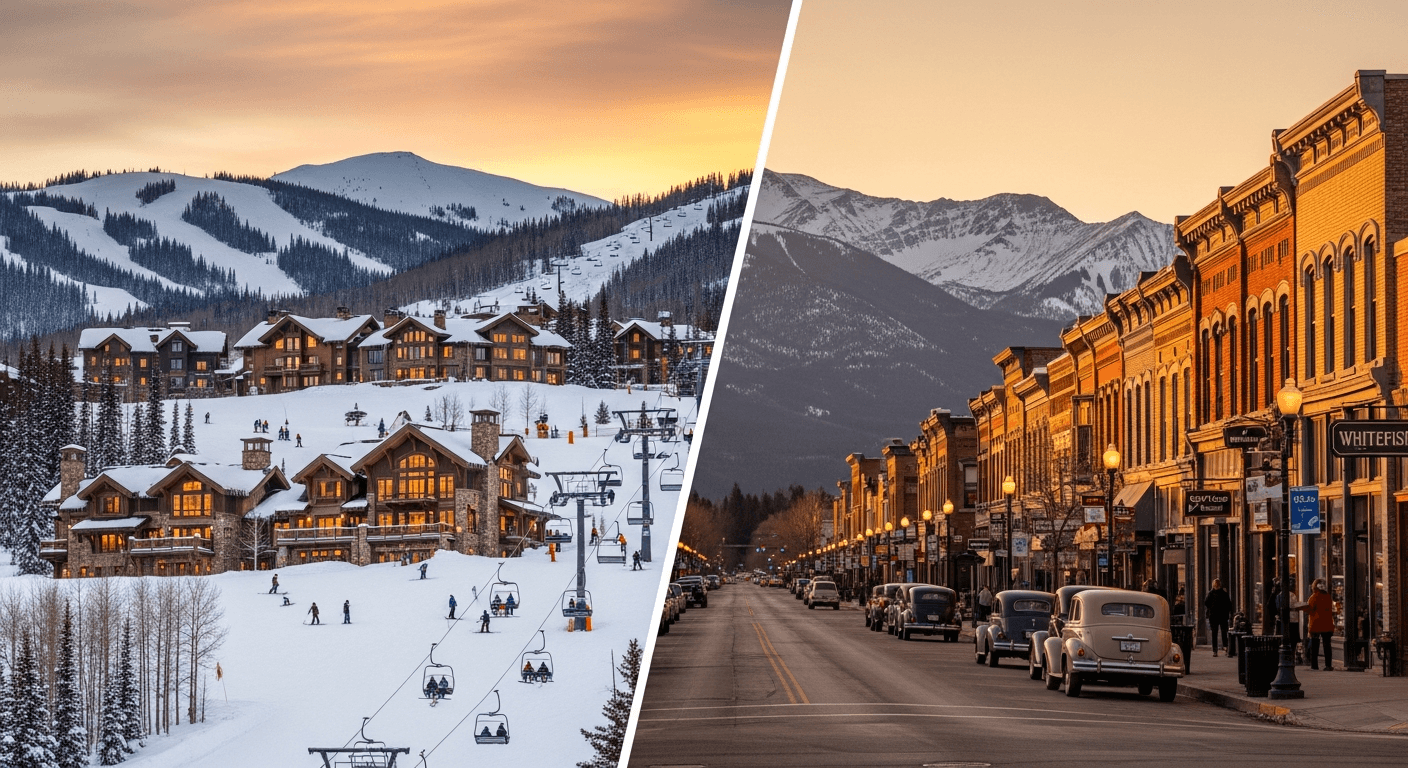
Whitefish punches above its size because of its proximity to Glacier National Park and the presence of Whitefish Mountain Resort, which has grown from a regional hill into a genuine destination over the past two decades. Tourism traffic from mid-June through early September and from mid-December through mid-March is significant. Shoulder seasons (April–early June, October–early December) are the quiet months locals value.
Housing: What You Actually Pay in 2026
| Property Type | Typical Range | Notes |
|—|—|—|
| Median SFH (Whitefish proper, Q1 2026) | $1.0M–$1.28M | 3BR/2BA, 1,800–2,400 sq ft |
| Entry luxury SFH | $1.5M–$3M | Near-lake access, updated, under 2 acres |
| True luxury SFH | $3M–$8M | Lakefront, custom build, 5,000+ sq ft |
| Ultra-luxury | $8M–$20M+ | Whitefish Lake shore, Iron Horse Club, estate acreage |
| Condo (in-town) | $550,000–$1.2M | Downtown or resort-adjacent |
| Ski-in/ski-out (Whitefish Mountain Resort) | $900,000–$4M | Slope access premium |
| Flathead Lake waterfront (45 min south) | $2M–$15M+ | Larger lake, different character — see our Flathead Lake waterfront guide |
| Rental (luxury 3BR long-term) | $4,500–$9,000/mo | Hard to find; most inventory is STR |
| Rental (modest 3BR long-term) | $2,800–$4,200/mo | Genuinely tight inventory |
The rental market is the most constrained part of Whitefish’s housing ecosystem. Short-term rental conversion, resort staff-housing pressure, and new-resident demand have made long-term inventory genuinely scarce. If you’re planning to rent for 6–12 months while you find a home, start that search at least 90 days before your arrival.
Montana’s Tax Picture — Why Buyers Keep Coming
Ready to see what’s available? Text Ashley at (406) 880-5985 for a confidential relocation conversation.
Montana’s tax profile is one of the clearer structural advantages of relocating to Whitefish. Three facts matter most:
1. No state sales tax. Montana is one of five U.S. states — along with Alaska, Delaware, New Hampshire, and Oregon — that levy no statewide general sales tax. Whitefish has a small local resort tax on lodging and prepared food, but no general retail sales tax applies to furniture, vehicles, electronics, clothing, or most taxable goods and services in the state.
2. Moderate property taxes. Effective property tax rates in Flathead County typically run 0.75% to 1.0% of assessed value on residential property, depending on mill levy and taxing district. That is well below Texas (1.6–1.9% effective), New York metro areas (2–3%+), and most New England markets, and is in line with California’s nominal rate (though California’s Proposition 13 reset mechanics change the math for long-term holders).
3. Progressive state income tax, top rate 5.65% in 2026. Montana consolidated to two brackets effective 2024 under reforms signed by Governor Gianforte, with the top rate stepping down from 5.9% in 2024 to 5.65% for tax year 2026. For comparison, California’s top rate is 13.3%, Oregon’s is 9.9%, and Washington and Wyoming have no state income tax. Montana is not the lowest-income-tax state in the Mountain West, but the overall mix favors buyers whose spending is high relative to their earned income.
Estimated Annual Property Tax by Home Value
| Home Value | Estimated Annual Property Tax | Effective Rate |
|—|—|—|
| $1.0M | $7,500–$10,000 | ~0.75–1.0% |
| $2.5M | $18,500–$25,000 | ~0.75–1.0% |
| $5M | $37,000–$50,000 | ~0.75–1.0% |
| $10M | $75,000–$100,000 | ~0.75–1.0% |
Important caveat: Montana conducted a statewide property reappraisal cycle in 2023 that generated meaningful jumps in residential assessed values. Mill levies adjust somewhat to offset those increases, but luxury buyers should budget for 3–8% nominal upward drift in tax bills over the next several assessment cycles as values catch up with transaction prices. For a deeper treatment of how property taxes are calculated and how Montana’s reappraisal cycle works, see our full Montana property taxes guide.
The No-Sales-Tax Savings, In Real Numbers
For buyers moving from California, Washington, or Texas, the sales-tax savings on large purchases compound quickly:
- $150,000 car: Approximately $10,800–$15,400 saved vs. California (7.25–10.25% combined state and local)
- $80,000 furniture order for a new build: $6,800–$8,300 saved vs. Washington (8.5–10.4%)
- $25,000 in annual dining, shopping, and services: $1,800–$2,600 saved annually vs. Texas (6.25–8.25%)
For a luxury household with $200,000–$400,000 of annual taxable spending, sales-tax savings alone typically run $15,000 to $40,000 per year. Montana’s 5.65% income tax offsets part of that for high earners, which is why Wyoming or Florida remain more tax-efficient for income-heavy households. For spending-heavy households at comparable income, Montana frequently nets out ahead.
Utilities: The Consistent Surprise
Winter utility costs are the single most consistent surprise for California and Texas transplants. Whitefish sits at 3,036 feet with a continental climate — January lows average in the mid-teens and snow accumulation runs 65–90 inches annually in town (more at the resort). Heating a 3,500–5,000 sq ft luxury home from November through March is expensive.
| Utility | Typical Whitefish (3,500 sq ft SFH) | Notes |
|—|—|—|
| Electric | $250–$450/mo summer, $350–$700/mo winter | Flathead Electric Cooperative; winter load spikes with resistance heat |
| Propane | $400–$900/mo winter | Many outlying luxury homes are propane-heated; summer negligible |
| Natural gas (where available) | $180–$350/mo winter | NorthWestern Energy; limited to town and close-in corridors |
| Water/sewer (municipal) | $100–$150/mo | Many outlying homes on well + septic |
| Internet (fiber) | $100–$180/mo | Montana Sky, CenturyLink fiber, Spectrum in parts of town |
| Trash/recycling | $45–$80/mo | Private service (Evergreen Disposal, Republic) |
| Snow removal (driveway) | $150–$400/event, 20–40 events/yr | Roughly $5,000–$12,000 per winter for a luxury property |
A 5,000 sq ft Whitefish luxury home commonly runs $1,200–$2,000 per month in combined heating and electric during peak winter months — December through February. Budget accordingly, and if you’re evaluating a specific home, ask the seller for 12 months of utility bills before you write an offer.
Groceries, Dining, and the Supply-Chain Premium
Whitefish’s remote location and limited regional competition push everyday costs 8–12% above the U.S. average on groceries and premium dining, with wine and spirits running noticeably higher than Pacific Northwest markets because most premium inventory routes in via Missoula or Seattle.
| Category | Whitefish | vs. Seattle | vs. Dallas |
|—|—|—|—|
| Weekly grocery spend (family of 4) | $350–$475 | ~95% of Seattle | ~110% of Dallas |
| Restaurant dinner for two (upper-mid) | $140–$220 | ~90% | ~115% |
| Fine dining ($$$$) | $250–$400 per person | ~95% | ~110% |
| Premium wine retail | — | +15–25% vs Seattle | +25–40% vs Dallas |
| Fuel (regular unleaded) | ~$0.15–$0.30/gal over national avg | Higher | Higher |
Grocery options in Whitefish: Super 1 Foods, Markus Foods, Third Street Market (organic/specialty), plus Walmart and Costco in Kalispell (15 min). There is no Whole Foods or Trader Joe’s in the valley — the closest are Missoula (2.5 hrs) and Spokane (3.5 hrs). Restaurant scene for a town of this size is credible: Latitude 48, Tupelo Grille, Ciao Mambo, and Mackenzie River Pizza cover most everyday needs, with seasonal fine-dining rotations layered on top.
Healthcare
Logan Health – Whitefish is a 25-bed critical-access facility — sufficient for routine and emergent care. Logan Health Kalispell (25 min south) is the regional hospital and the clinical anchor for the Flathead Valley, with expanded cardiology, orthopedics, oncology, and surgical services. For specialized care not available locally — complex cardiac surgery, advanced oncology, major neurosurgery — patients are referred to Spokane (3.5 hrs by car / 45 min by small jet), Seattle, or Salt Lake City.
Concierge medicine is available through MDVIP-affiliated practices in the Kalispell/Whitefish area. Expect $2,500–$6,000 per year in membership fees on top of standard care costs. For UHNW households, maintaining an existing Mayo, Cleveland Clinic, or Stanford relationship and flying out when needed via FCA is workable given the airport’s direct-flight network.
Schools
Whitefish School District is consistently high-performing and has been one of Montana’s stronger public districts for the past decade. Whitefish High, Whitefish Middle, and the three elementary schools are well-resourced, with class sizes that routinely sit below the state average. District enrollment has grown from roughly 1,600 to 1,950 students over ten years, which has driven recent facility investments.
Private alternatives in the broader Flathead Valley include:
- Stillwater Christian School (Kalispell) — K–12
- Kalispell Montessori — early childhood and elementary
For high-school-aged students, most families choosing private education look toward boarding options in Spokane, Seattle, or the Front Range, since the local private high-school bench is thin.
Most luxury families I work with choose Whitefish Public Schools for K–8 and sometimes transition to boarding or out-of-state private for high school. Whitefish is materially less private-school-heavy than Aspen or Park City.
Transportation and Air Access
Glacier Park International Airport (FCA) in Kalispell is 15 minutes from downtown Whitefish and is the single biggest infrastructure advantage Whitefish has over comparably sized Montana towns. Scheduled direct-flight markets in 2026 include Seattle (Alaska, daily year-round), Minneapolis (Delta, daily), Denver (United, daily), Chicago, Atlanta, Dallas, and Los Angeles on seasonal rotations.
FCA also has a general aviation terminal with full FBO service — Red Eagle Aviation and Glacier Jet Center — with hangar, fuel, and handling for aircraft up to Challenger 350 / Gulfstream G280. Larger aircraft can operate but hangar space is constrained, so plan ahead.
Lifestyle Costs: Clubs, Recreation, Seasonal Spend
| Item | Annual Range |
|—|—|
| Iron Horse Golf Club (private) | $40,000–$80,000 initiation + ~$18,000–$28,000 annual dues |
| Whitefish Lake Golf Club (semi-private) | $6,000–$12,000 |
| Whitefish Mountain Resort season pass (family of 4, adult + teen mix) | $3,000–$4,500 |
| Boat slip (Whitefish Lake) | $4,500–$18,000 depending on size/location |
| Boat storage (winter, covered) | $1,200–$3,500 |
| Ski equipment (family of 4, seasonal turnover) | $3,500–$8,000 |
Iron Horse is the local private club with golf, fitness, dining, and lake access. The waitlist is real — budget 18–36 months from application to active membership.
Hidden Costs Most Transplants Underbudget
- First-year winterization of a new home: $8,000–$25,000 (pipe insulation, driveway heat tape if applicable, emergency generator, winter tires for every vehicle, outdoor faucet covers, proper roof maintenance program)
- Snow removal contract: $5,000–$12,000 annually for a luxury property with a long driveway
- Vehicle winter costs: Dedicated winter tire sets ($1,000–$1,500 up front, lasting multiple seasons), plus more frequent alignments, faster brake wear, and higher fuel consumption in cold weather — budget roughly $1,000–$2,000 of additional annual operating cost per vehicle once amortized
- Wildlife-proofing: Bear-resistant trash containers, secure food storage, electric fencing for any agricultural use — roughly $3,000–$8,000 one-time
- Home insurance wildfire loading: Flathead Valley wildfire exposure has pushed homeowner’s premiums up materially. Expect $6,000–$15,000 annually on a $3M–$5M home, and carriers are conducting more thorough inspections before binding coverage
- Well water testing and filtration: Annual testing $200–$400; filtration and softening systems run $3,000–$8,000 installed
- Septic maintenance: $400–$900 for a pump-out every 3–5 years on outlying homes
- Travel premium: Frequent-traveler households often shift toward NetJets, Flexjet, or local charter to maintain coastal business schedules — a real budget line, not a vanity item
Whitefish vs. Bozeman vs. Missoula
Montana’s three luxury-relevant markets each have a distinct cost and lifestyle profile. A rough comparison:
| Factor | Whitefish | Bozeman | Missoula |
|—|—|—|—|
| Median SFH (2025 / early 2026) | ~$950K–$1.1M+ | ~$750K–$900K | ~$550K–$650K |
| Luxury entry ($2M+) | Readily available | Readily available | Thinner inventory |
| Property tax effective rate | ~0.75–1.0% | ~0.85–1.1% | ~0.9–1.1% |
| Nearest major airport | FCA (15 min) | BZN (20 min) | MSO (10 min) |
| Ski access | Whitefish Mountain Resort 25 min | Big Sky ~1 hr, Bridger Bowl 20 min | Snowbowl 20 min, Lost Trail ~1.5 hr |
| National park access | Glacier 35 min | Yellowstone ~1.5 hr | Neither immediate |
| Grocery / dining depth | Moderate (8,000 pop) | Strong (~56,000 pop) | Strong (~75,000 pop) |
| Winter heating cost | Higher (coldest) | High | Moderate |
| Year-round town feel | Yes | Yes | Strongest |
Whitefish is the most resort-adjacent of the three, with the clearest winter recreation and national-park story. Bozeman has the strongest economic growth and the most buyer demand, and is the closest Montana equivalent to a full-service metro. Missoula is the most affordable, has the best year-round urban density for Montana, and the weakest pure resort lifestyle.
For a head-to-head on the Whitefish–Bozeman-area luxury comparison, see our Big Sky vs Whitefish guide and Best Neighborhoods in Missoula overview.
Annual Operating Cost by Home Value — Rule of Thumb
| House Value | Expected Annual Operating Cost | Includes |
|—|—|—|
| $1.5M | $35,000–$55,000 | Taxes, utilities, routine maintenance, insurance |
| $3M | $65,000–$100,000 | Adds landscaping, snow-removal scale, pool/spa if applicable |
| $5M | $110,000–$175,000 | Adds occasional staff (housekeeping, property caretaker) |
| $10M+ | $250,000–$500,000+ | Full-time property manager common |
These figures exclude club memberships, vehicles, travel, and discretionary lifestyle spend. They represent what it realistically costs to own and operate the real estate itself.
Who Whitefish Fits — and Who It Doesn’t
Whitefish works best for buyers who:
- Want a functioning year-round town, not a resort shell
- Value direct Glacier National Park and Whitefish Lake access
- Are building a 10+ year holding, not timing a short flip
- Can absorb winter operating costs without complaint
- Have work and life arrangements that don’t require weekly coastal presence
It is a harder fit for buyers who:
- Require Whole Foods / Trader Joe’s / large-metro restaurant density
- Need ultra-trophy-market status (Aspen and Jackson have that ceiling; Whitefish does not)
- Travel internationally on a weekly cadence from a legacy coastal base
- Are unprepared for five months of real winter operating reality
The financial case is real. The operational case is real. The question — as with every mountain-town move — is whether the life you’ll actually live here matches the life you want.
Frequently Asked Questions
Does Montana have a sales tax?
No. Montana is one of five U.S. states with no general statewide sales tax, along with Alaska, Delaware, New Hampshire, and Oregon. Whitefish has a small local resort tax on lodging and prepared food, but no general retail sales tax applies to vehicles, furniture, electronics, clothing, or most goods and services purchased in Montana.
What are property taxes in Whitefish, MT in 2026?
Effective property tax rates in Flathead County typically run between 0.75% and 1.0% of assessed value on residential property, depending on mill levy and specific taxing district. On a $2.5M home, expect roughly $18,500–$25,000 in annual property taxes. Montana completed a statewide reappraisal cycle in 2023; nominal tax bills on luxury property have drifted upward since, and buyers should budget for continued 3–8% annual increases over the next several assessment cycles.
What is Montana’s state income tax rate?
Montana consolidated to two income tax brackets effective tax year 2024 under reforms signed by Governor Gianforte. The top marginal rate stepped down from 5.9% in tax year 2024 to 5.65% for tax year 2026. This is lower than California (13.3%), Oregon (9.9%), and Minnesota (9.85%), but higher than Wyoming, Washington, South Dakota, Texas, Florida, and Tennessee, which have no state income tax.
Is Whitefish more expensive than Bozeman or Missoula?
For luxury housing, yes. Median single-family home prices in Whitefish (~$950K–$1.1M+ in early 2026) run above Bozeman (~$750K–$900K) and well above Missoula (~$550K–$650K). Winter utility costs in Whitefish also tend to exceed Missoula, which sits lower in elevation and has milder winters. Bozeman’s overall cost of living is comparable to Whitefish, with stronger grocery and dining infrastructure; Missoula is the most affordable of the three.
How much does it cost to heat a Whitefish luxury home in winter?
Heating a 5,000 sq ft home in Whitefish during peak winter months (December–February) typically runs $1,200 to $2,000 per month in combined heating and electric costs, depending on construction quality, insulation, heating system (propane, electric, or limited natural gas), and thermostat discipline. Expect winter bills to be 3–4x summer baseline.
What does home insurance cost in Whitefish given wildfire risk?
Wildfire exposure has materially tightened the Flathead Valley homeowner’s insurance market since 2020. On a $3M–$5M luxury home, budget $6,000 to $15,000 annually, with carriers conducting thorough inspections before binding coverage and often requiring defensible-space compliance. Premiums on homes in higher-risk forested corridors can run well above that range. Work with an independent broker familiar with Montana’s current carrier landscape.
Is there public transportation in Whitefish?
Minimal. Mountain Climber (Eagle Transit) provides limited bus service around the Flathead Valley, and SNOW Bus operates a seasonal shuttle between Whitefish and Whitefish Mountain Resort during ski season. For daily life, a vehicle — and in practice two vehicles per household, one of them set up for winter — is effectively required.
How does Whitefish’s cost of living compare to Jackson, Aspen, or Park City?
Meaningfully lower. Median luxury entry in Whitefish sits near $2M versus $5M in Jackson, $8M in Aspen, and $3M in Park City. Annual operating costs on a 5,000 sq ft home run roughly $80K–$140K in Whitefish versus $180K–$320K in Aspen. The structural reason is that Whitefish is still priced as a regional luxury market rather than a national trophy market — which is precisely why many buyers prefer it.
What are typical rental costs in Whitefish?
Long-term rental inventory is tight. A modest 3-bedroom runs $2,800–$4,200 per month; a luxury 3-bedroom runs $4,500–$9,000 per month. Availability is the bigger issue than price — short-term rental conversion and resort staff-housing demand have compressed the long-term market. Plan 90+ days of lead time if you need to rent before buying.
Ashley’s Take
I have guided a lot of relocations into the Flathead Valley, and the pattern I see repeatedly is this: buyers overweight the tax story and underweight the operating story. Montana’s no-sales-tax, moderate-property-tax, reasonable-income-tax profile is real — it genuinely saves luxury households $20,000 to $75,000 a year versus California or New York. But winter operating costs, wildfire insurance, supply-chain premiums on everyday goods, and snow-removal contracts can quietly consume a meaningful share of those savings in the first 24 months if you didn’t budget for them.
What Whitefish delivers that the brochure doesn’t capture is a year-round town with real schools, a real hospital, a real grocery infrastructure, and direct access to Glacier National Park and Whitefish Mountain Resort — at a price point that is 40–60% of what Jackson, Aspen, or Park City now command. For buyers who care about the life more than the trophy, the arithmetic still works.
If you are seriously considering a move to Whitefish in 2026, I would be glad to walk you through current inventory that fits your profile, the operating-cost realities of specific neighborhoods, and the handful of off-market opportunities I am tracking right now.
Ashley Inglis
Real Estate Advisor & Broker, MT Lux Real Estate
📞 (406) 880-5985
Serving buyers and sellers of luxury property across the Flathead Valley, Whitefish, Bigfork, Missoula, and all of Montana’s premier markets.
Get in Touch
Ready to talk about your Montana move?
Ashley Inglis and the MT Lux team are ready when you are. Reach out for a private consultation about buying, selling, or just exploring the market.
More Reading