Flathead Lake Waterfront Homes — What Buyers Need to Know in 2026
By Ashley Inglis, Real Estate Advisor & Broker, MT Lux Real Estate Living on Flathead Lake: Real Estate, Lifestyle & Waterfront Living Flathead Lake is the largest natural freshwat
By Ashley Inglis, Real Estate Advisor & Broker, MT Lux Real Estate
Living on Flathead Lake: Real Estate, Lifestyle & Waterfront Living
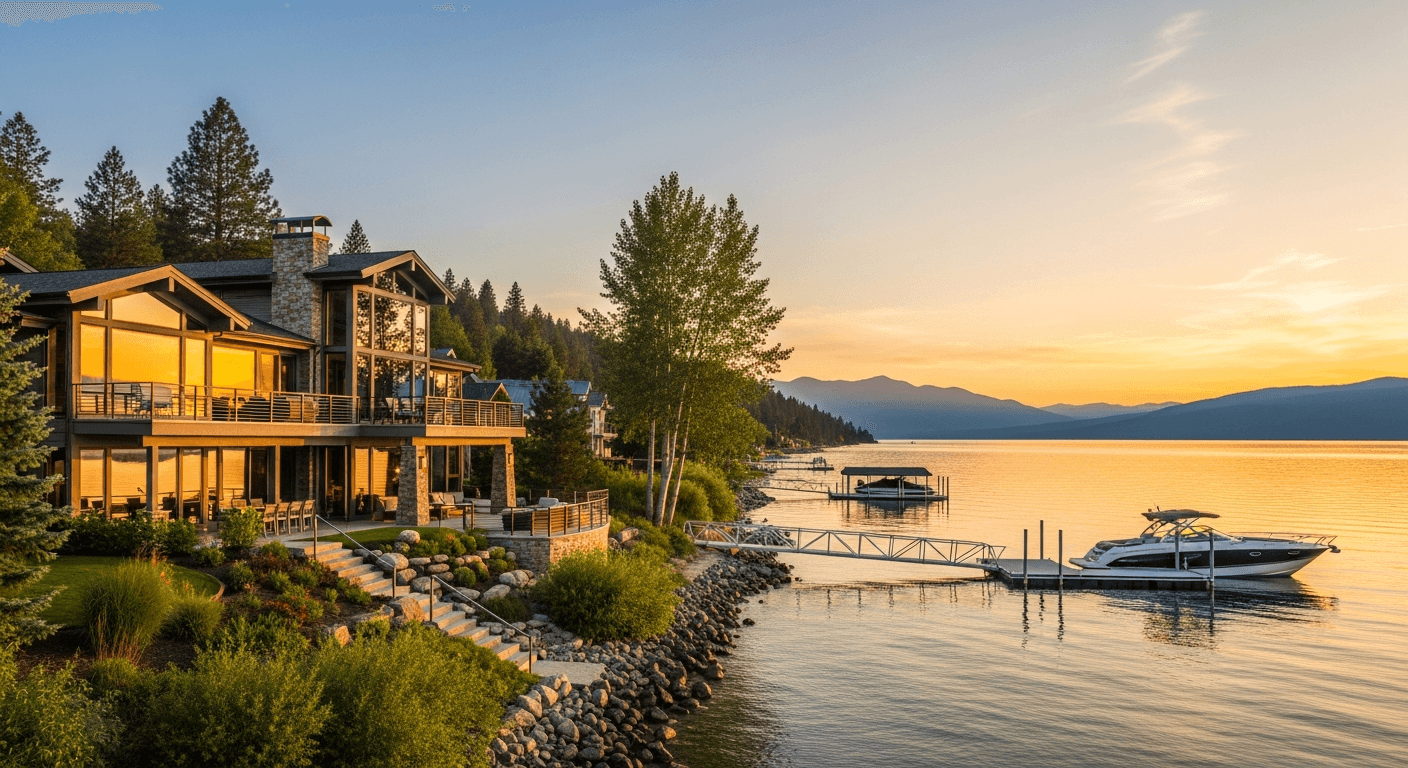
Flathead Lake is the largest natural freshwater lake west of the Mississippi — 28 miles long, up to 370 feet deep, and wrapped in 185 miles of shoreline. For luxury buyers, it is Montana’s premier lake market, and the four sub-markets (East Shore, West Shore, North/Polson, and the southern Flathead Reservation stretch) each behave like distinct micro-economies. Lakefront single-family homes currently trade from roughly $2M for an entry-level frontage parcel to north of $20M for the best estates; lakeview homes run $800K–$3M, and the small condo inventory sits between $500K and $1.5M. Before you write an offer, you need to understand dock rights, lakeshore protection zones, and — on the south end — the critical distinction between fee land and Flathead Reservation lease land. Here is the 2026 buyer’s guide.
A Freshwater Inland Sea in the Northern Rockies
Most lake markets in the United States are lakes. Flathead is something larger.
Twenty-eight miles long, up to sixteen miles wide, with a maximum depth of 370 feet and a surface area of roughly 200 square miles, Flathead Lake is the remnant of a glacial basin carved by the same ice sheets that shaped Glacier National Park, visible to the north on a clear day. Its water clarity is studied by the Flathead Lake Biological Station and consistently ranks among the cleanest large lakes in the populated world — in summer, visibility often exceeds twenty feet.
It is also, uniquely among American lakes of this size, still genuinely rural. There is no Tahoe-style ring of casinos, no Lake-of-the-Ozarks density. Cherry orchards, hay meadows, and conservation-protected forest make up most of the shoreline. The towns that punctuate it — Bigfork, Lakeside, Somers, Polson, Woods Bay — are measured in thousands of residents, not tens of thousands. You can still find mile-long stretches of undeveloped shore.
That scarcity, combined with growing demand from Pacific Northwest, Texas, and California buyers, has driven the lake’s luxury market into a new tier over the past five years. Properties that traded for $2 million in 2019 now list at $5 million. Waterfront vacant lots have quietly become one of the most constrained real estate supplies in Montana.
The Four Shores of Flathead — Each Is Its Own Market
Flathead Lake behaves like four distinct sub-markets, defined by geography, light, access, and jurisdiction. Understanding which one fits your life is the first real decision a buyer makes.
East Shore — Bigfork, Woods Bay, Yellow Bay
The East Shore is the most photographed stretch of the lake — the one you see in glossy Montana magazines. Running north-to-south along Highway 35 from Bigfork past Woods Bay, Yellow Bay, and Finley Point, it is backed by the Swan Range, forested in Douglas fir and larch, and oriented to catch the morning sun across the water.
Bigfork sits at the extreme northeast corner where the Swan River enters the lake. It is the cultural center of Flathead Lake — the Bigfork Summer Playhouse, a genuine working-artist community, boutique shopping on Electric Avenue, and a curated restaurant scene that punches well above its population. Bigfork is zoned for Bigfork School District, widely considered the strongest K-12 public district on the lake.
Woods Bay is five minutes south — a tighter-knit, residential stretch with smaller lots and a mix of legacy family cabins and newer luxury builds. Inventory here is thin in any given month.
Yellow Bay and Finley Point are further south, more rural, and home to the University of Montana’s Flathead Lake Biological Station. Parcels get larger, prices moderate slightly, and the feel shifts from village to countryside.
East Shore waterfront typically ranges from $2.5M to $10M for single-family homes, with premier Bigfork Bay and Woods Bay estates crossing $12M–$20M when they trade.
West Shore — Lakeside, Somers, Rollins, Big Arm
The West Shore runs along Highway 93 and faces east across the water toward the Swan Range. Its defining characteristic is afternoon and evening light — long, golden hours as the sun drops behind the Salish Mountains at your back.
Lakeside is the commercial and residential anchor — small-town services, a public boat launch, and a growing tier of new-construction luxury homes on the water and on the bench above it. Lakeside has seen the most active new-build market of any Flathead community over the past five years.
Somers sits at the very north end where the Flathead River exits toward Kalispell. Easier road access than anywhere else on the lake — ten minutes to Kalispell, fifteen to Glacier Park International Airport (FCA).
Rollins and Big Arm are further south — quieter, more rural, with some of the lake’s most dramatic open views toward Wild Horse Island. Big Arm State Park and the Big Arm area offer a mix of waterfront homes and bench-view estates.
A West Shore advantage most buyers underweight: proximity to Blacktail Mountain Ski Area, fifteen minutes up the mountain from Lakeside. It is a small, locals’ ski hill with zero lift lines — a real amenity if you want a lake-and-ski dual-season property without Whitefish-level traffic.
West Shore waterfront typically ranges from $1.8M to $8M, with premier Lakeside and Big Arm estates reaching $10M–$15M+.
North — Somers, Kila, the Flathead River Mouth
The North end of the lake, where the Flathead River enters, offers a different character: marshy wetlands, wildlife corridors, and significantly easier year-round road access. Somers proper has a public beach and boat ramp; Kila stretches inland toward Kalispell.
This is the zone to look at if your primary constraint is convenience — ten minutes to Kalispell hospitals, groceries, and the airport, while still owning legitimate Flathead Lake frontage. Trade-off: the water is shallower here, marshier in places, and the view corridors are less dramatic than East or West Shore.
North-end waterfront typically ranges from $1.2M to $4M, with larger estate compounds occasionally crossing $6M.
South — Polson and the Flathead Reservation
The South shore is a different country, economically and legally.
Polson anchors the southern end of the lake in a natural amphitheatre with some of the most cinematic lake-and-mountain views available anywhere on Flathead. The Mission Mountains rise sharply to the east; cherry orchards roll down to the water. Polson is the commercial hub for the lake’s southern half — a regional hospital, full-service town, and genuine year-round community.
Pricing on the south end runs materially below the north end. Lakefront homes typically range $700K to $2.5M, with premier estates crossing $4M–$5M. For buyers willing to drive another thirty minutes from Glacier Park International Airport, this is the best value play on Flathead Lake.
But — the south shore includes portions of the Flathead Indian Reservation, home of the Confederated Salish and Kootenai Tribes (CSKT). Most of the land on the East Shore south of Yellow Bay and along the south and southwest shore falls within reservation boundaries. We cover what that means for ownership below.
What Actually Drives Waterfront Pricing
Two houses on Flathead Lake can sit a quarter-mile apart and price four times differently. The variables that matter:
1. Linear Frontage Feet
The single most-weighted factor. A hundred feet of frontage is an entry-level lakefront position; two hundred feet is desirable; three hundred feet or more is rare and premium-priced. Expect to pay $15,000–$40,000 per frontage foot on Flathead, depending on shore, water depth at the dock, and view quality.
2. Dock Rights and Dock Configuration
Not every lakefront lot has dock rights, and not every lot can accommodate a dock that fits a modern wake boat or 30-foot cruiser. An existing, permitted, deep-water dock adds meaningful value and can be effectively impossible to replicate on a new lot due to tightened lakeshore regulations.
3. Protected Cove vs. Open Water
Protected coves — Bigfork Bay, Woods Bay, parts of Big Arm, Skidoo Bay — command premiums because they deliver calm water, safer swim zones, and better boat security in Flathead’s occasionally dramatic afternoon wind.
4. Water Depth at Shore
Shallow, marshy frontage is materially less valuable than deep-water frontage where a boat can tie up at the dock year-round.
5. Lot Size and Topography
Level lots at water’s edge price above steep-banked lots with long staircases down to the water. Acreage matters, but on Flathead the scarcity premium is frontage, not back land.
6. Build Condition
A tear-down on premium frontage can trade at land value plus a small building bonus. A new-construction or recently renovated luxury home on the same frontage can trade at a $3M–$5M premium over the tear-down.
Dock Rights, Riparian Rules, and the Lakeshore Protection Zone
Every county around Flathead — Flathead County on the north and east, Lake County on the south — administers a Lakeshore Protection Zone extending twenty horizontal feet from the ordinary high-water mark. Any construction, grading, tree removal, or dock modification within this zone requires a lakeshore protection permit, and permits are meaningfully harder to secure than they were a decade ago.
Key things a buyer needs to verify before closing:
1. Does the property have an existing, permitted dock? If yes, is the permit transferable, and does it cover the dock’s current configuration?
2. Are there any unpermitted structures or shoreline modifications on record? Unpermitted seawalls, retaining walls, or shoreline fill can become the buyer’s legal liability after closing.
3. What is the dock’s depth at the end? Some docks on historically shallow frontage no longer accommodate modern boats and cannot be extended without a new permit.
4. Are there conservation easements on the property? A number of Flathead Lake parcels carry conservation easements restricting subdivision, outbuildings, or shoreline development. Easements can be completely compatible with luxury ownership, but they must be read carefully.
5. Is boat lift and mooring buoy placement grandfathered?
A qualified Flathead Valley real estate attorney should review these items on every waterfront transaction. I have the short list of attorneys I recommend to my clients.
Flathead Reservation — Fee Land vs. Lease Land
This is the single most important legal distinction on the south and southwest lake, and most out-of-state buyers do not arrive understanding it.
The Flathead Indian Reservation, home of the Confederated Salish and Kootenai Tribes, covers 1.3 million acres including the south half of Flathead Lake. Within reservation boundaries, land falls into several categories:
- Fee land — Privately owned in fee simple, fully transferable, functionally indistinguishable from any other private real estate transaction. Much of the non-tribal shoreline on the south lake is fee land.
- Tribal trust land — Owned by the tribe or by the federal government in trust for the tribe, not available for fee purchase.
- Allotted trust land — Held in trust for individual tribal members, occasionally available on a long-term lease basis but not in fee.
- Long-term leased land — Structures owned by a non-tribal resident on land leased from tribal or allotted owners, typically on twenty-five to fifty-year leases.
A leased-land property can be a legitimate and enjoyable ownership experience, but it is not the same asset as fee-simple waterfront. Financing is narrower (few national lenders lend against leased tribal land), resale buyer pools are smaller, and lease renewal terms need to be understood in detail.
Non-tribal buyers should also understand that certain tribal regulations — fishing, hunting, boating permits, water-rights protocols — apply across the reservation whether your specific parcel is fee or trust land. The CSKT have been thoughtful stewards of the lake, and most regulations are sensible, but they differ from off-reservation Montana and you should know them before you close.
The bottom line: on the south lake, always confirm in writing whether the parcel is fee land or lease land before making an offer, and always work with an agent and attorney who have transacted inside Reservation boundaries before.
Climate, Geography, and Why People Keep Choosing This Lake
Flathead Lake sits at roughly 2,900 feet of elevation in a valley sheltered by mountains on three sides. The microclimate is one of the mildest in Montana. Summers are warm and dry — July and August daytime highs average in the low 80s, with cool evenings. The lake moderates temperatures enough that the east shore supports a working cherry industry, and Flathead cherries are a genuine regional brand.
Winters are cold but not extreme by Montana standards. The lake rarely freezes over fully — only twice in the last thirty years has it fully frozen — which makes lakefront living genuinely four-season in a way that most northern-tier lake markets are not.
The position within the Crown of the Continent ecosystem is the other piece. Glacier National Park’s west entrance is an hour north of Bigfork. Whitefish Mountain Resort — one of the largest ski resorts in the country by skiable acreage — is about ninety minutes from most of the lake. Blacktail Mountain is fifteen minutes from Lakeside. Hiking, fly-fishing (the Flathead River system is a blue-ribbon fishery), mountain biking, and wilderness access are all immediate.
Glacier Park International Airport (FCA) in Kalispell is the luxury buyer’s logistical anchor: direct flights to Seattle, Portland, San Francisco, Los Angeles, Denver, Minneapolis, Chicago, Dallas, Atlanta, and (seasonally) New York and several East Coast cities. For buyers who need to get on a plane, Flathead is easier to reach than most people realize.
Who Is Actually Buying Here in 2026
The Flathead Lake luxury buyer has shifted over the last seven years. In rough proportion to what I am seeing on my transactions:
- Pacific Northwest technology money — Seattle and Portland executives and founders, primarily. A two-hour flight makes Flathead a realistic second-home market rather than a vacation destination. This has been the dominant buyer cohort since 2019.
- California buyers — Bay Area tech and Los Angeles entertainment, often relocating primary residence or establishing a substantial second home. California buyers tend to write the largest tickets.
- Texas buyers — Houston, Austin, Dallas. Summer-escape buyers who want to leave Texas heat from June through September.
- Mountain West relocators — Denver, Salt Lake, and increasingly Boise buyers who have priced out of their local luxury markets and find Flathead offers more lake, more privacy, and comparable amenity access.
- Legacy Montana families and Midwest multi-generational buyers — A smaller but stable cohort, often buying with twenty-year holding horizons.
Flathead Lake Shore Comparison
| Factor | East Shore (Bigfork/Woods Bay) | West Shore (Lakeside/Somers/Rollins) | Polson (South) |
|—|—|—|—|
| Light exposure | Morning sun across water | Afternoon/evening sun | Mixed, amphitheatre views |
| Forest/terrain | Heavily forested, Swan Range behind | Drier, Salish Range behind | Cherry orchards, Mission Range |
| Town amenities | Strong (Bigfork village) | Moderate (Lakeside services) | Strong (regional hub) |
| Schools | Bigfork K-12, top-rated | Somers/Lakeside, solid | Polson, solid |
| Airport (FCA) | 45 min | 20 min | 75 min |
| Nearest skiing | Whitefish, 90 min | Blacktail, 15 min | Blacktail, 60 min |
| Waterfront SFR range | $2.5M – $10M (premier to $20M+) | $1.8M – $8M (premier to $15M+) | $700K – $2.5M (premier to $5M) |
| Reservation land? | Fee land (N of Yellow Bay) | Mostly fee land | Mix — must verify per parcel |
| Feel | Cultured, walkable, forested | Open, sunny, convenient | Affordable, dramatic, rural |
Frequently Asked Questions
What is the current median sale price for Flathead Lake waterfront?
Across all four shores, median waterfront single-family sale price is running approximately $2.4M–$2.6M in 2026, with average sale price well above that due to high-end transactions. Median varies dramatically by shore — Bigfork median is meaningfully higher than Polson median.
How many lakefront homes are on the market at any given time?
Typically 60 to 80 single-family waterfront listings across the entire lake, plus roughly 50 to 70 vacant lakefront parcels. Inventory turns slowly — premium frontage often trades quietly before hitting MLS. A good buyer’s agent is the difference between seeing inventory and seeing real inventory.
Can I build a new dock on a Flathead Lake lot?
Possibly, but new dock permits in Flathead County’s Lakeshore Protection Zone have become significantly more constrained. If a property lacks an existing permitted dock, do not assume you can build one — verify with the county and a lakeshore protection specialist before you buy.
What taxes should I expect?
Montana has no sales tax, and property taxes on Flathead Lake luxury homes run roughly 0.75% to 1.1% of assessed value annually, though assessments and mill rates vary by county (Flathead County vs. Lake County) and by taxing district. Montana also has a state income tax (progressive, up to roughly 5.9% in 2026), which matters primarily for buyers establishing residency. For a deeper treatment, see my Montana property taxes overview.
Is Flathead Lake a year-round or seasonal community?
Both. The core lakeside communities — Bigfork, Polson, Lakeside, Somers — are genuine year-round towns with full services, schools, and hospitals. Waterfront homeownership can be either — many owners winterize and leave, others live lakeside year-round. Unlike many lake markets, Flathead has real winter infrastructure.
How does Flathead Lake compare to Whitefish Lake?
Whitefish Lake is smaller (roughly 3,300 acres vs. 128,000 acres), more expensive per frontage foot, and tightly integrated with the town of Whitefish and its ski resort. Flathead is larger, more varied, offers more inventory and a wider price spectrum, and trades slightly lower per linear frontage foot on average. Buyers who want walk-to-town ski-town energy lean Whitefish; buyers who want scale, variety, and more value lean Flathead. I’ve written a fuller comparison in my Whitefish Lake vs. Flathead Lake waterfront guide.
Do I need to worry about wildfire risk?
Wildfire is a real consideration in the Flathead Valley, but lakefront properties — sited on water, typically with defensible space — are generally lower-risk than forested interior properties. Insurance carriers have tightened underwriting in Montana over the past three years; expect thorough inspections and work with a broker familiar with Montana carriers.
Are there HOA-managed or shared-access lakefront communities?
Yes, particularly on the West and North shores. Shared-access developments with common docks, beaches, and HOA-managed amenities offer a lower entry point to Flathead Lake living — typically $500K to $1.5M for condos and HOA-governed homes. These are a legitimate ownership category and often the right fit for buyers who want lake access without sole-ownership maintenance responsibilities.
Ashley’s Perspective
I have been representing buyers and sellers in the Flathead Valley long enough to have closed transactions on all four shores of this lake. What I tell every serious buyer is this: Flathead Lake is not one market. It is four markets that happen to share a body of water, and the difference between Bigfork and Polson, or between Lakeside and Yellow Bay, is not a pricing difference — it is a lifestyle difference. Figure out which life you are buying, then we find the right frontage.
The other thing I tell buyers: premium Flathead frontage does not reliably hit the MLS. If you want to see the inventory that actually matters — the estate that has been in one family for forty years, the Bigfork Bay compound that is about to be listed, the Big Arm parcel that the owner is quietly testing — you need an agent who is inside those conversations. That is what I do.
If you’re considering Flathead Lake waterfront in 2026, I would be glad to walk you through current inventory, the shores that fit your profile, and the handful of off-market opportunities I am tracking right now.
Ashley Inglis
Real Estate Advisor & Broker, MT Lux Real Estate
📞 (406) 880-5985
Serving buyers and sellers of luxury property across the Flathead Valley, Whitefish, Bigfork, and all of Montana’s premier lake markets.
Get in Touch
Ready to talk about your Montana move?
Ashley Inglis and the MT Lux team are ready when you are. Reach out for a private consultation about buying, selling, or just exploring the market.
More Reading