Remote Work & Montana Real Estate
By Ashley Inglis, Real Estate Advisor & Broker, MT Lux Real Estate The remote-work migration that began in 2020 has matured into something more strategic. Five years in, the buyers
By Ashley Inglis, Real Estate Advisor & Broker, MT Lux Real Estate
The remote-work migration that began in 2020 has matured into something more strategic. Five years in, the buyers I'm now working with in Whitefish are not the trial-relocators of 2021 — they're software engineers, finance professionals, healthcare executives, and creative directors who have already been remote for half a decade and are now choosing where they want to live for the next twenty years. Whitefish keeps showing up at the top of that shortlist. The reasons are practical, infrastructural, and lifestyle — not just scenery.
This guide unpacks who is actually moving here, what they're paying, what to verify before you put in an offer, and how to think about Whitefish as a primary residence rather than a vacation second home.
The remote-worker buyer profile we're seeing in Whitefish
Across closings on the Flathead Valley side of my book, the dominant remote-worker buyer right now falls into a few clear archetypes:
- Tech and finance professionals leaving California, Washington, and the Northeast. These are W-2 employees of companies that now permit fully distributed work, or self-employed consultants who serve clients across multiple time zones.
- Mid-career executives buying a "forever home" rather than a getaway. Many have already owned a Whitefish second home for several years and are now selling the primary residence in their original metro and consolidating here.
- Health care and biotech professionals — a growing cohort working for telehealth networks, remote pathology, or research roles where physical proximity to a hospital campus matters less than it used to.
- Founders and small-business owners running operations remotely. Whitefish's airport access (Glacier Park International, FCA, only a short drive away) is a non-negotiable for this group.
What these buyers all share: they care about the quality of the day-to-day life, not the novelty of it. They're not moving here to ski every weekend (most of them ski less than five days a year). They're moving here because the trail system, the lake, the airport, the schools, and the absence of metro friction add up to a better operating environment for the way they actually live and work.
Why Whitefish specifically — versus Bozeman, Coeur d'Alene, Park City
Buyers comparing Western mountain towns usually have a shortlist that includes Bozeman, Coeur d'Alene, Park City, Jackson, and Sun Valley. Whitefish gets selected for a specific set of reasons:
- Lower price-per-square-foot than Park City, Jackson, or Sun Valley. Median listing prices in Whitefish in 2026 are still meaningfully below those resort markets, especially for non-slopeside primary residences.
- Smaller, more contained downtown core. Whitefish has a real, walkable Main Street with restaurants, a working theater, and locally owned retail — it has not been overrun the way Bozeman has experienced in the last five years.
- Glacier Park International Airport (FCA) with daily nonstops to Seattle, Salt Lake City, Denver, Minneapolis, Chicago, Atlanta, Dallas, and seasonal expansion. Most remote workers can get to a major hub in under three hours of door-to-gate.
- No state sales tax in Montana, which materially affects total cost of living for a household with significant discretionary spending.
- Genuine four-season lifestyle — Whitefish Mountain Resort in winter, Whitefish Lake and Glacier National Park in summer, an extensive trail and forest-service network year-round.
For buyers who want the resort-town energy of Park City or Jackson, Whitefish is not the answer — those markets are deliberately bigger and more hospitality-driven. For buyers who want a real town that happens to be next to extraordinary outdoor access, Whitefish is the better fit.
The infrastructure question: internet, power, redundancy
This is the part of the conversation that surprises buyers, and it's the part most worth doing your homework on before writing an offer.
Internet: In-town Whitefish and most of the established subdivisions on the south and east sides of the lake have access to high-speed wired internet through multiple providers, including fiber in many areas. Outside of those zones — including significant parts of the Flathead Valley north of town and into the canyon roads — you can drop into satellite-only territory very quickly. Starlink has dramatically improved that experience in the last few years, and many remote workers I represent now run Starlink as either their primary or backup connection. But before you offer on a property, especially a rural or canyon parcel:
- Ask the seller for screenshots of recent speed tests on the actual property
- Independently verify the address with the providers you'd plan to use
- Confirm that any "fiber to the property" claim actually means fiber to the structure, not fiber within a quarter-mile
Power: The Flathead Valley is well-served by Flathead Electric Cooperative and NorthWestern Energy. Most properties have reliable grid power. Outage frequency varies — in-town Whitefish is generally excellent, more remote areas can experience longer outages during major winter storms. Many of the homes I sell at the higher price points include whole-home generators, and if you're buying as a primary remote-work residence, I'd strongly suggest making one a non-negotiable part of your scope.
Cellular: Coverage in town is strong. As you move out toward Glacier Park, into Big Mountain canyon roads, or onto the west and north sides of Flathead Lake, expect dead zones. If you take live calls during the workday, this matters.
What remote workers are actually paying in Whitefish in 2026
The 2026 Whitefish market is more nuanced than headline numbers suggest. A few patterns from current inventory and recent closings:
| Property type | Typical 2026 price range | What you generally get |
|---|---|---|
| In-town Whitefish single-family | Roughly $900K – $1.6M | Walkable to downtown, smaller lots, mature trees, generally reliable connectivity |
| Established subdivisions (Iron Horse, Whitefish Hills, etc.) | Roughly $1.4M – $3M+ | Larger lots, golf or open-space adjacency, HOA-managed |
| Lakefront on Whitefish Lake | Mid seven figures and up | Frontage, dock access, dramatically constrained inventory |
| Slopeside / ski-resort area | Roughly $1.5M – $5M+ | True ski-in/ski-out is rare; "ski resort area" is a much wider category |
| Acreage parcels (5–40+ acres) | Wide range, $1M – $5M+ depending on view, water, and access | The infrastructure verification above is critical |
These ranges shift quarter to quarter and the right answer for a specific buyer is always going to depend on the exact corridor, the lot, the home's vintage, and what's transacted in the prior 90 days. I update buyers I'm working with on actual comps, not market-wide averages, because the averages mask the variance that matters.
Tax and cost-of-living considerations remote workers should understand
Montana's tax structure is one of the most-misunderstood elements of relocating here. The high points:
- No state sales tax. Period. This affects everything from a new pickup truck to a household renovation.
- State income tax exists, with a top rate that as of 2026 is competitive with most other Western states but is not zero. If you're moving from a no-income-tax state (Texas, Florida, Washington, Tennessee), this is a real change to model with your CPA.
- Property taxes are reassessed periodically and have moved meaningfully in recent cycles, particularly in the Flathead Valley where appreciation has been strong. Don't price your future tax bill off the seller's current bill — ask the assessor or your title company to model what's likely to happen at your purchase price.
- Insurance costs, especially for properties in or near forested areas, have risen across the West. Wildfire risk pricing has tightened. Get a quote from a Montana-licensed insurance broker before, not after, you go under contract on a more rural property.
For most remote workers I work with leaving California or the Northeast, total all-in cost of living drops meaningfully, even with the income tax — primarily driven by no sales tax, lower housing-cost-per-square-foot, and the sharp drop in commuting and discretionary urban spending.
The "remote-work compatible home" feature checklist
After working with this buyer profile for several years, here is the practical feature list that genuinely matters when you're going to work from a home, not just visit it:
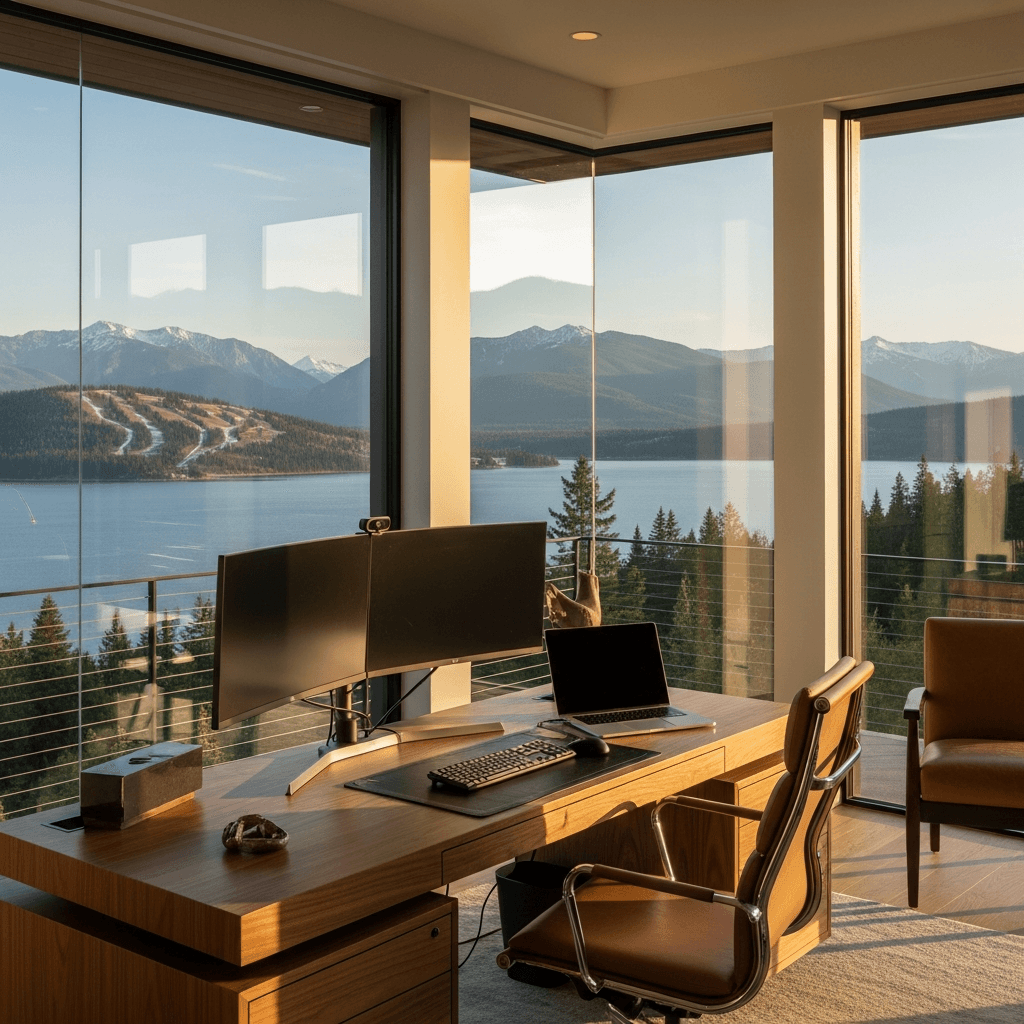
- A real home office — ideally a separate room with a door, north or east light to reduce screen glare, and the ability to control sound. A loft alcove off the great room reads beautifully on a listing photo and works poorly when your spouse is on a call thirty feet away.
- Hard-wired Ethernet drops to the office, or at minimum a clear plan for running them. Wi-Fi alone is fine until it isn't.
- Generator or generator-ready electrical service. Whole-home generators are the gold standard for remote workers; transfer-switch-ready panels are an acceptable starting point.
- HVAC that handles the actual seasonal range. Whitefish summers can hit the 90s; winters routinely run below zero. A home that was designed primarily for summer use can become very expensive to operate in February.
- Mudroom and gear storage. This is a Montana feature, not a luxury. Skis, fly rods, bikes, and dog gear need a home; a great house without one frustrates daily life.
- Walkability or short-drive access to town. Remote workers who go into town for coffee, lunch, the gym, or kid activities are dramatically happier in homes within ten minutes of Main Street than in homes thirty minutes out.
Schools, family considerations, and community
A growing share of the remote workers moving to Whitefish are doing it with school-aged kids. The Whitefish School District has a strong reputation in the state, with K–12 housed across several campuses, an active outdoor-education tradition, and competitive athletics. There are also several private and faith-based options in the broader Flathead Valley, and a meaningful homeschool community.
For families, the question I get most often is whether Whitefish has enough "community" for kids — meaning sports leagues, music programs, clubs, and the everyday social fabric that makes a small mountain town livable through a long winter. The honest answer is yes, but it takes about a year of intentional showing-up to build into. The families I see thrive here are the ones who join things in their first season — youth ski team, hockey, the theater company, a church, a volunteer board — rather than waiting for connection to find them.
Common mistakes I watch remote-worker buyers make
A short list of patterns I see repeatedly:
- Buying too rural for the lifestyle they actually want. A 20-acre parcel with mountain views is romantic. A 20-acre parcel with mountain views thirty-five minutes from a grocery store on a road that ices over from December to March is a different reality.
- Underestimating renovation timelines. Western Montana has a deep, talented contractor base, but it is a small market. Quality builders are booked out. If the home needs significant work, plan in months, not weeks, and budget contingencies generously.
- Treating Whitefish like a vacation market when buying a primary residence. Trophy homes near the resort that work beautifully for two weeks of holiday use can be wrong for a primary residence — too far from town, too poorly oriented for daily living, too expensive to operate year-round.
- Skipping the long visit. Buyers who visit only in July or only in February consistently miss something they wish they'd known. If you're buying as a primary, try to spend time here in shoulder season — late October, early April — when the real cadence of the valley reveals itself.
- Not pre-negotiating renovation and connectivity scope into the offer. The right time to ask the seller to install a generator transfer switch or to share fiber-installation receipts is before close, not after.
Frequently Asked Questions
Is Whitefish a good place for someone who works fully remotely?
For most professional roles, yes — provided you do the connectivity and infrastructure homework on the specific property. In-town Whitefish has reliable, fast wired internet, multiple cellular carriers, and strong grid power. Outside of established corridors, the answer becomes property-specific, and a Starlink + generator pairing is becoming standard among the remote workers I represent in more rural locations.
How does Whitefish compare to Bozeman for remote workers?
Bozeman is larger, faster-growing, and more economically diverse, with Montana State University and a more developed tech ecosystem. Whitefish is smaller, slower, more contained, and more outdoor-oriented. Both have real airports. For a remote worker who values a smaller-town pace and Glacier National Park access, Whitefish often wins; for someone who wants the energy of a university town and a deeper local job market in case remote work changes, Bozeman often wins.
Will my employer let me move to Montana?
This is between you and your HR department, but the practical reality is that Montana is a state most U.S. employers can payroll in without unusual difficulty. The bigger questions are usually around state-tax nexus for employers without a Montana presence, and around any role-specific in-person requirements. Have that conversation in writing before you commit to a purchase.
How much should I budget for total cost of homeownership in Whitefish?
A reasonable rule of thumb at the $1.5M–$3M price point is to budget property taxes, insurance, HOA (where applicable), utilities (including snow removal), and maintenance reserves on top of your mortgage payment. For most homes in this range, that envelope can run $2,500–$5,500 per month before your mortgage principal and interest, depending on the property. Get specifics, not estimates, before you write an offer.
Does Whitefish have year-round livability or is it a seasonal town?
It's year-round. Roughly 8,000 full-time residents, a working downtown, year-round restaurants, year-round school calendar, year-round medical and professional services. Tourism volume swings hard between seasons, but the underlying community continues steadily. Most of the remote workers who move here for the right reasons describe shoulder-season Whitefish as their favorite version of it.
Can I rent the home short-term when I'm away?
That depends on the specific property. Whitefish's short-term rental rules vary by zoning and HOA. Some neighborhoods allow it, some prohibit it, some allow it with permits. If short-term rental income is part of your purchase thesis, verify the rules for the exact property — and verify them with the city or county, not just with the listing agent.
Working with MT Lux Real Estate as a remote-work buyer
A meaningful share of my buyer clients are professionals relocating from out of state for exactly the reasons covered here. Our process is built around how that buyer actually shops:
- A property-specific connectivity and infrastructure check before you write an offer, not after
- Shoulder-season visits so you see the valley in its working state, not its postcard state
- A renovation and contractor short-list for properties that need work, with realistic timelines
- A coordinated handoff with your CPA, your insurance broker, and your relocation tax planner — because the right property decision is also a tax and lifestyle decision
If you're considering a move to Whitefish or anywhere in the Flathead Valley, I'd be glad to walk you through current inventory, the specific corridors that fit your lifestyle, and the verification work that should happen before you commit.
Let's talk
Reach out to schedule a market briefing or a private property tour. Most of my remote-worker clients close after one focused visit, and the difference between a great move and a frustrating one is almost always the work that happens in the first conversation.
Contact MT Lux Real Estate — Ashley Inglis, Real Estate Advisor & Broker, (406) 880-5985.
Get in Touch
Ready to talk about your Montana move?
Ashley Inglis and the MT Lux team are ready when you are. Reach out for a private consultation about buying, selling, or just exploring the market.
More Reading