Western Montana Comparison
Missoula vs Bozeman Real Estate
Two of Montana’s most-talked-about markets, compared honestly — pricing, lifestyle, climate, schools, and which town fits which kind of buyer.
Recognized Excellence




Missoula and Bozeman get compared constantly. Both are college towns, both sit at the foot of mountains, and both have grown faster than most of Montana over the last decade. Underneath that surface they trade in different ways. Bozeman is closer to Yellowstone, has a higher median price, and skews toward newer construction and out-of-state capital. Missoula sits in a river valley further west, prices a bit lower, and has held a more local, university-anchored character.
This page is the honest side-by-side. Ashley Inglis represents the Missoula side directly. For buyers and sellers needing Bozeman or Big Sky coverage, she refers through the REALM Global network to a vetted Gallatin County agent — and stays involved coordinating both ends when the move is intra-Montana.
Median Price & Inventory
Price, Days on Market, and Inventory
Bozeman has run materially more expensive than Missoula across 2023–2025. The median single-family price in Bozeman has tracked roughly 20–35% higher than Missoula depending on the quarter, with the luxury tier ($2M+) significantly deeper in Bozeman due to proximity to Big Sky, Yellowstone Club spillover, and concentrated wealth migration from California and the Front Range.
Missoula is not cheap — it’s the second-most expensive standalone metro in Montana — but the entry point is meaningfully lower. A turnkey 3–4 bedroom in a desirable Missoula submarket (Lower Rattlesnake, Grant Creek, South Hills) trades in a band where Bozeman’s comparable inventory often sits 25%+ higher. Days on market in both markets have normalized off 2021–2022 lows; both now resemble healthy seasonal markets rather than feeding frenzies.
Inventory mix differs too. Bozeman’s new construction share is higher, especially north and west of town. Missoula has more established mid-century and pre-war stock in the central neighborhoods, with new construction concentrated on the edges (Mullan Trail corridor, South Reserve).
Lifestyle & Climate
Lifestyle, Climate, and Daily Rhythm
Both towns are mountain towns. The day-to-day feel diverges in specific ways.
Missoula
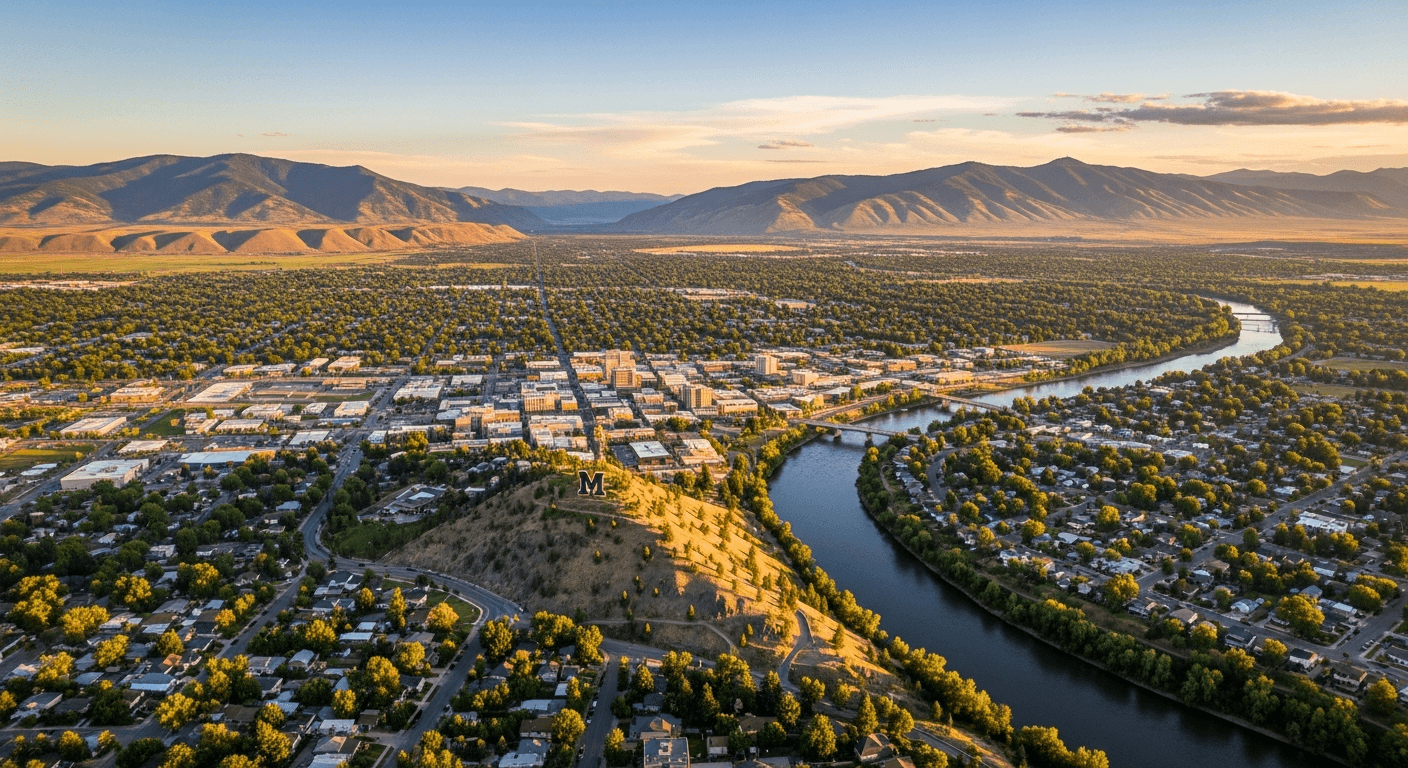
Missoula sits in a wide valley where five rivers and creeks converge, with the Clark Fork running through downtown. The University of Montana drives a continuous undergraduate and graduate population, anchoring an arts, music, and food scene that runs year-round. Winter inversions can settle gray, cold air into the valley for stretches in January and February — a real consideration for buyers sensitive to light and air quality. Summers are warm and dry with cool evenings.
Outdoor access is immediate: Rattlesnake Wilderness trailhead from town, Blue Mountain to the south, Pattee Canyon for trails, and a 90-minute drive to either Glacier’s south side or the Bitterroot’s ranches and rivers.
Bozeman
Bozeman sits in a higher, more open valley with longer sight lines to the Bridger, Tobacco Root, and Spanish Peaks ranges. Winters are colder than Missoula on average and snowier, but with less inversion — the air stays cleaner and the light stays brighter through January. Summers are similar but cooler in the evenings due to elevation.
Bozeman’s growth has driven a more polished, more expensive food and retail scene, with a faster pace and noticeably more out-of-state capital. The college (MSU) is engineering- and agriculture-anchored rather than liberal-arts, which shapes a different downtown character.
Connectivity
Airports, Drive Times, and Yellowstone Access
Connectivity is where the practical case for each town gets made.
- Missoula (MSO) — Daily nonstops to Seattle, Denver, Salt Lake, Minneapolis, Dallas, Chicago, and seasonal direct service to additional hubs. A solid mid-sized airport, ~15 minutes from downtown.
- Bozeman (BZN) — Larger flight network than Missoula, more nonstops, more carriers, and significantly more capacity into LAX, JFK, and Atlanta. Reflects the volume of high-net-worth and out-of-state second-home traffic into Big Sky.
- Yellowstone access — Bozeman is 90 minutes to the West Yellowstone entrance and ~45 minutes to Big Sky. Missoula is a 4–5 hour drive to Yellowstone — functionally a weekend trip, not a day trip.
- Glacier National Park access — Missoula is ~2.5 hours to West Glacier. Bozeman is 5+ hours. This is the mirror trade-off of the Yellowstone equation.
- Inter-Montana drive — Missoula and Bozeman are ~200 miles apart on I-90, roughly a 3-hour drive in good weather.
Schools & Community
Schools, Universities, and Family Fit
Both towns have strong public-school systems by Montana standards, with comparable test outcomes in core elementary and middle grades. Missoula County Public Schools and Bozeman School District are both rated well, with the usual variability by individual school.
The university effect is different. University of Montana (Missoula) is liberal-arts-anchored with strong programs in journalism, law, forestry, and environmental studies. Montana State (Bozeman) is engineering, agriculture, and physics-anchored with a much larger student body that has reshaped the town faster.
For families, Missoula tends to feel more settled and walkable in the core neighborhoods (Lower Rattlesnake, University District, South Hills). Bozeman’s growth has been more sprawling, with newer family neighborhoods further from the historic downtown. Neither town has a private-school tradition at the scale of larger metros.
Choosing Between Them
Choose Missoula If — Choose Bozeman If
The clean version of the trade-off:
- Choose Missoula if Glacier and the Bitterroot are your priority outdoor anchors, you value a lower entry price, you want a liberal-arts university town with strong music and food scenes, and you don’t mind occasional winter inversions.
- Choose Missoula if you want easier nonstop access to Seattle and the Pacific Northwest, and a slower, more local-feeling community.
- Choose Bozeman if Yellowstone and Big Sky skiing are the anchor, your budget supports a 25%+ premium on comparable inventory, and you want the broadest nonstop airline network in Montana.
- Choose Bozeman if you prefer drier, brighter winter air at the cost of colder temperatures, and you want an engineering-and-ag university culture rather than liberal-arts.
- Either works if you’re relocation-flexible — both deliver real Montana, real mountains, and a college-town anchor. The decision usually comes down to a single weighted factor: price, park access, or airport.
Common Questions
Frequently Asked Questions
- Is Bozeman more expensive than Missoula?
- Yes, materially. Median single-family prices in Bozeman have run roughly 20–35% above Missoula across 2023–2025 depending on the quarter, with the gap widest in the luxury tier ($2M+) due to Big Sky and Yellowstone Club spillover. Missoula’s entry point on comparable turnkey inventory is meaningfully lower.
- Which is colder, Missoula or Bozeman?
- Bozeman is colder on average, particularly in January and February, due to higher elevation and a more open valley. Missoula is warmer but more prone to winter inversions that trap cold, gray air in the valley for stretches. Both get real Montana winters — Bozeman’s is more consistently cold and bright, Missoula’s is milder but grayer.
- Does Ashley Inglis represent buyers in Bozeman?
- Ashley’s direct representation is Western Montana — Missoula, the Bitterroot Valley, and the Flathead. For buyers needing Bozeman or Big Sky coverage, she refers through the REALM Global network to a vetted Gallatin County agent and stays involved coordinating both ends of an intra-Montana move when needed.
- Which airport is better, MSO or BZN?
- Bozeman (BZN) has the broader flight network, more nonstops to coastal hubs, and more capacity overall — a reflection of Big Sky and Yellowstone traffic. Missoula (MSO) has solid nonstops to Seattle, Denver, Salt Lake, Minneapolis, Dallas, and Chicago. For most relocators, both work. For frequent coastal travelers or international connections, BZN is stronger.
- Is Missoula or Bozeman better for raising a family?
- Both have strong public schools and family-friendly neighborhoods. Missoula tends to feel more walkable and settled in its core neighborhoods, with shorter distances to schools and a more compact downtown. Bozeman has grown faster and more sprawling, with newer family neighborhoods further from the historic center. The right answer depends on what you weigh more: walkable established or newer-build with more square footage.
- How far apart are Missoula and Bozeman?
- About 200 miles on I-90, roughly a 3-hour drive in good weather and longer in winter. They’re close enough that some buyers consider both during a Western Montana search, but distinct enough that almost no one commutes between them.
Continue Exploring
Related Western Montana Guides
About the Author
Meet Your Western Montana Broker, Ashley Inglis
Ashley Inglis is a Western Montana Broker, RealTrends Verified 2025 honoree, REALM member, Certified Luxury Home Marketing Specialist (CLHMS), and Accredited Buyer’s Representative (ABR), serving buyers and sellers across Missoula, Whitefish, Bigfork, Hamilton and surrounding Montana luxury markets.
Next Steps
Schedule a Consultation with Ashley
Every consultation is private and tailored to your specific situation. Whether you’re evaluating Western Montana for the first time, considering a move within the region, or preparing to list, Ashley reviews each engagement personally before taking it on.