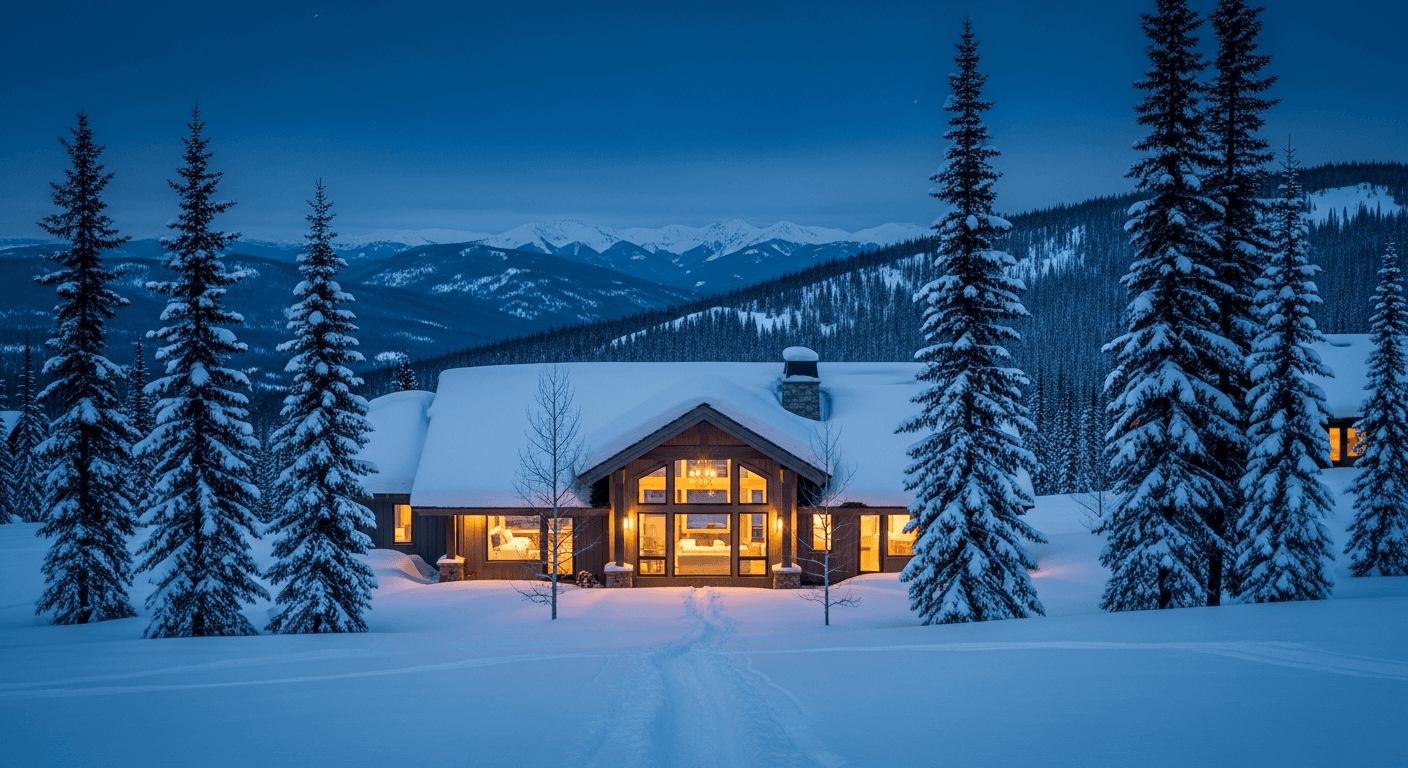
Guide to Buying a Vacation Home in Whitefish, Montana
By Ashley Inglis, Real Estate Advisor & Broker, MT Lux Real Estate Whitefish has become one of the most-shopped vacation-home markets in the Northern Rockies, and for a defensible
By Ashley Inglis, Real Estate Advisor & Broker, MT Lux Real Estate
Whitefish has become one of the most-shopped vacation-home markets in the Northern Rockies, and for a defensible reason: a real four-season town with an airport that puts you 15 minutes from a Gulfstream or an Alaska Airlines direct flight, a 3,000-acre ski resort 25 minutes up the hill, Glacier National Park 25 minutes east, and Whitefish Lake right in the back yard. What it is not is a discount market, a passive income machine, or a place where you can buy in October and break-even by next summer. This guide is the operational reality of owning a Whitefish vacation home in 2026 — financing differences, the short-term rental rules that actually matter, the neighborhoods that make sense for different buyer profiles, and the winter operating costs that California, Texas, and Florida buyers consistently underestimate.
What "Vacation Home" Actually Means to a Lender
The first decision in this process is not which neighborhood — it's how the IRS, your lender, and your tax CPA will classify the property. The labels matter because the financing terms, the tax treatment, and the rental rules are all different.
| Classification | Personal Use | Rental Use | Typical Financing Premium vs. Primary |
|---|---|---|---|
| Primary residence | 100% | Disallowed | Best available rates — baseline |
| Second home (true vacation) | ≥14 days/year AND not rented more than 14 days/year | Up to 14 days/year, no income reporting | +0.125%–0.375% over primary rates; 10% down minimum (often 20%) |
| Vacation rental (mixed use) | Personal use, but rented >14 days/year | Rented up to ~180 days/year while still mixed-use | +0.25%–0.625% over primary; 15%–20% down |
| Investment property | Minimal/no personal use | Year-round rental | +0.75%–1.5% over primary; 20%–25% down |
The IRS line at 14 personal-use days is the critical threshold. Stay there 14 days or fewer in a year (or fewer than 10% of total rental days, whichever is greater) and the property is essentially treated as a business — rental losses become deductible against rental income, depreciation gets aggressive, but you also lose the second-home mortgage-interest deduction.
What I see most Whitefish vacation buyers do is structure as a true second home for the first 2–3 years (no rentals or minimal rentals to friends), then re-evaluate. The reason: the rate spread between second-home financing and investment-property financing in 2026 is roughly 50–75 basis points. On a $1.5M loan, that's $7,500–$11,250 per year. That's real money, and it dwarfs the rental income most owners will actually clear after management fees, cleaning, and turnover.
If you're buying in cash, this distinction matters less for financing but still drives your insurance class and your property-tax treatment. Montana's new second-home property tax tier (more on that below) is a separate conversation.
Montana's 2026 Property Tax Reset for Vacation Homes
This is the single biggest 2026 change vacation-home buyers need to understand. Montana's legislature restructured residential property taxation in 2025, and the changes are taking effect now.
The headline: second homes and short-term rentals now sit in a separate, higher property tax class. Primary residences (homeowner-occupied) qualify for a graduated rate that effectively reduces their tax bill — second homes don't. The current second-home/STR rate is set at roughly 1.90% of full assessed value, compared to a tiered structure that gives long-term primary residents an effective rate closer to 0.65%–0.95%.
For a Whitefish vacation home:
| Assessed Value | Estimated 2026 Annual Property Tax (Second Home) |
|---|---|
| $1.0M | $19,000 |
| $1.5M | $28,500 |
| $2.5M | $47,500 |
| $5M | $95,000 |
| $8M | $152,000 |
This is materially higher than Montana's primary-residence treatment and meaningfully higher than what 2024 Whitefish vacation owners were paying on the same property. Build the new number into your purchase math, not the old number. I see buyers running 2023 tax bills off Zillow's history and underwriting the deal on stale data — that's a $10,000–$30,000 annual miss on a luxury vacation home.
Owners who can credibly establish Montana residency (driver's license, voter registration, ≥7 months physical presence) shift to the primary-residence class and recover most of that gap. For UHNW buyers whose business or family obligations make Montana residency impractical, the higher tax is the cost of admission.
Whitefish's Short-Term Rental Rules — The 90-Second Version
Whitefish has some of the most specific, most enforced short-term rental rules in the Northern Rockies. If you're buying with rental income as part of your underwriting, this is where deals get made or broken.
Inside Whitefish city limits, short-term rentals (defined as rentals under 30 days) are permitted only in specific zoning districts: WB-3, WRR-1, WRR-2, WRB-1, and WRB-2. Outside of those zones, short-term rental is not allowed — full stop. Even inside the permitted zones, every operator must:
- Apply for and hold a Whitefish Short-Term Rental Permit and Business Registration
- Pass an annual Fire Marshal inspection
- Carry a State of Montana public accommodation license (administered through the Flathead City-County Health Department)
- Meet off-street parking standards
- Collect and remit Whitefish Resort Tax
- List a 24/7 local contact for problems
Outside city limits in unincorporated Flathead County, the rules are different but tightening. Many county residential zones now require permits for vacation-rental use, and individual subdivisions can layer their own CC&R restrictions on top. A 2025 Montana Supreme Court decision confirmed that subdivision covenants prohibiting short-term rental are enforceable even where county zoning would allow them. The HOA and covenant documents are not optional reading. I've seen buyers close on what they thought was a turnkey STR play, only to discover that the subdivision's recorded covenants explicitly prohibit rentals under 30 days.
Practical 2026 buyer rule: before you write an offer on any Whitefish property where rental income is part of the model, verify three documents — the zoning designation, the city or county STR permit history for the address, and the recorded HOA covenants. If any of the three says no, the income disappears. Our broader Glacier Park Area Real Estate guide covers the gateway-town STR landscape for properties outside Whitefish proper.
Vacation Neighborhoods That Actually Work
Not every Whitefish neighborhood makes sense as a vacation home. Some are zoned out of short-term rental use, others are too far from the amenities that justify the trip, and others have HOAs that don't allow seasonal owners to use property managers without restrictions. The neighborhoods below are the ones I send most vacation buyers to first.
Whitefish Mountain Resort Village (Big Mountain)
The resort base. Condo inventory dominates here — Kintla Lodge, Morning Eagle, Edelweiss, Ptarmigan Lodge, Snow Bear Chalets, Northern Lights. Most resort HOAs allow short-term rental, and the ski-season demand is strong enough that the right unit can clear $60,000–$140,000 in gross rental revenue across the winter and summer combined. 2026 pricing: 1BR condos $650K–$950K; 2BR $850K–$1.4M; 3BR luxury $1.5M–$2.4M.
Trade-off: you're 25 minutes up a winding mountain road from downtown Whitefish, restaurants, and the lake. In summer, the resort runs hiking, mountain biking, and a scenic chairlift, but it's a quieter scene than the lake corridor. For full slopeside detail, see our Ski-In Ski-Out Homes in Whitefish guide.
Iron Horse Golf Club
Whitefish's flagship private equity club, located between downtown and the resort. Members get golf, on-mountain ski access via a private lift, a lake clubhouse, and a curated luxury chalet inventory. Iron Horse is the highest-end vacation neighborhood at Whitefish — entry chalets run $3M–$5M, premier homes reach $8M–$15M+. Initiation fees and dues are a separate, six- to seven-figure conversation.
Iron Horse is the right answer for buyers who want a fully-amenitized luxury experience and don't intend to rent the property. Most Iron Horse owners do not short-term rent.
Whitefish Lake Estates / Lakeshore Drive
The Whitefish Lake corridor — east and west shore. Lakefront and lake-access vacation homes trade between $2M and $15M+ depending on linear feet of waterfront, dock rights, and acreage. This is the "I want my kids to swim and waterski" neighborhood. STR rules are variable depending on exact location (some properties are inside city limits, some county); verify per-property.
Lake corridor buyers should also read our Cost of Living in Whitefish MT guide — boat slips, winter storage, dock maintenance, and ice-out timing all matter to lake ownership economics.
Lion Mountain / Houston Point
Quiet wooded neighborhoods on the south and west sides of Whitefish Lake. Single-family inventory dominates. 2026 pricing: $1.2M–$3.5M. Some lake views, generally larger lots than the in-town inventory, and a 5–10 minute drive into downtown Whitefish. Mixed STR permissibility — verify each property.
Downtown Whitefish (City Core)
Walkable to restaurants, the Whitefish Theatre, the train depot, and the lakefront city park. Inventory is mostly older bungalows and a small condo segment. 2026 pricing: $750K–$2M. Downtown is dense with vacation owners and the city's enforcement of STR rules is tightest here — assume city permit required, fire inspection mandatory.
Bigfork (Flathead Lake Northeast Shore)
A 45-minute drive south of Whitefish on Flathead Lake's northeast shore. Larger lake (largest natural freshwater lake west of the Mississippi), warmer summer water, longer boating season, and a charming village. Vacation home inventory ranges $750K–$8M+ depending on waterfront vs. view. Bigfork is the right answer for buyers more focused on the lake than on the ski resort. Some buyers split: a smaller Whitefish resort condo for ski season, a larger Bigfork lake home for summer.
Lakeside (Flathead Lake West Shore)
Across the lake from Bigfork, on the west shore. Generally lower price points than Bigfork for comparable waterfront — entry waterfront from $1.1M, premier estates to $10M+. Closer to Kalispell and the airport (20–25 minutes) but further from Whitefish town center (45 minutes).
What It Actually Costs to Operate
Vacation owners chronically under-budget Whitefish operating costs. Use the table below as a calibration check before you finalize any deal.
| Cost Category | 1,800 sq ft Condo | 3,500 sq ft Chalet | 5,500 sq ft Lake Home |
|---|---|---|---|
| Property taxes (2026 second-home rate) | $11,000–$18,000 | $19,000–$45,000 | $45,000–$95,000 |
| HOA / club dues | $4,800–$14,400 | $0–$8,000 | $0–$15,000 |
| Winter heating (Dec–March) | $2,400–$4,200 | $5,200–$8,400 | $8,000–$14,000 |
| Electric (annual) | $1,800–$3,000 | $3,600–$6,500 | $5,500–$9,500 |
| Water/sewer (city) or well/septic | $1,200–$1,800 | $1,800–$3,000 | $2,200–$4,000 |
| Internet / fiber | $1,200–$2,200 | $1,400–$2,400 | $1,400–$2,400 |
| Snow removal (driveway + paths) | Included in HOA | $5,000–$10,000 | $6,000–$14,000 |
| Lawn / landscaping | Included in HOA | $3,500–$8,000 | $6,000–$18,000 |
| Property management (monthly checks) | $200–$500/mo | $400–$800/mo | $600–$1,500/mo |
| Homeowner insurance | $1,800–$3,200 | $4,500–$9,000 | $9,000–$22,000 |
| Cleaning (between trips) | $200/visit | $350–$600/visit | $600–$1,200/visit |
| Total non-rental annual | $30,000–$50,000 | $55,000–$110,000 | $95,000–$210,000 |
Two line items consistently shock first-time vacation owners: winter heating and homeowner insurance.
Winter heating on a 5,500-square-foot home in Whitefish, with sustained overnight lows of 0°F to -20°F and occasional -30°F runs in January and February, can hit $1,800–$3,500 per month at the peak. Most Whitefish luxury homes burn propane, not natural gas — propane prices float, and tank refills run $4–$7 per gallon on a 500-gallon tank, twice per winter.
Homeowner insurance has moved sharply over the past three years. Wildfire risk in parts of the Flathead Valley has driven carriers to either non-renew, raise premiums 40%–80%, or require defensible-space inspections before binding coverage. Brush clearance, roof material, generator presence, and proximity to fire-hydrant infrastructure all matter. Get an insurance quote before removing the inspection contingency, not after.
Snow Removal — The Hidden Operating Cost
Snow management at a Whitefish vacation home is not a winter weekend chore — it's a full operations function the property needs every storm, whether you're there or not. A 200-foot driveway with a 20-event winter (typical) costs $5,000–$8,000 in driveway plowing alone. Add steps, a shoveled path to the front door, snow-shed monitoring on metal roofs, and freeze-prevention on water spigots, and the line item climbs.
Three operating models work for vacation owners:
Contract a local snow removal company with automatic dispatch on accumulation triggers (typically 2"–3" of new snow). Cost: $4,000–$12,000 per winter depending on driveway length and property layout. Reliability varies — the top two or three operators in Whitefish are booked by August.
Use a full-service property manager who bundles snow removal, plumbing checks, and weekly inspections. Cost: $600–$1,800 per month, year-round. Best for owners who are absent more than three weeks per winter month.
Onsite caretaker for larger estates. Cost: $50,000–$120,000/year fully loaded if part-time; $90,000–$160,000 if dedicated full-time. Realistic only on $4M+ properties.
Buyers from warm-climate states (California, Texas, Florida, Southeast) consistently underestimate this. If you've never owned a property that requires active winter operations, plan to over-budget the first year and adjust.
Financing the Purchase
A few mechanical notes on financing a Whitefish vacation home in 2026:
Conforming-loan limits don't cover most Whitefish luxury inventory. The 2026 single-family conforming loan limit in Flathead County is $806,500 for Fannie/Freddie. Above that, you're in jumbo territory. Most second-home buyers in Whitefish above $1.5M end up with portfolio jumbo financing through a private-bank relationship (J.P. Morgan, First Republic legacy lenders, Schwab Bank, Bank of Montana, Glacier Bank).
Cash-out from a primary residence still beats most jumbo second-home rates. If you have meaningful equity in a California, New York, or Florida primary, drawing a HELOC or cash-out refi against that property to fund the Whitefish purchase frequently lands at a better blended rate than financing the Whitefish home directly.
Pledged-asset lines (PAL/SBL) against a brokerage account are the cleanest cash structure for UHNW buyers. Rates floats with SOFR but typically lands inside jumbo. Most of my $3M+ buyers in 2025 used PAL structures to close in cash, then refinanced into a long-term mortgage 6–12 months later when the right loan structure stabilized.
DSCR loans for declared rental properties are available through specialty lenders if you're explicitly buying as an investment property. Rates are higher (typically 7.5%–9.0% in early 2026) but the qualification is income-from-property rather than personal income — useful for buyers whose tax returns don't tell the full income story.
Rental Income — What the Math Actually Says
If you're buying a Whitefish vacation home that you'll rent when not in use, here's the realistic 2026 picture:
| Property Type | Gross Annual Rental (Full-Time STR) | Owner-Use Reduction | Realistic Net to Owner |
|---|---|---|---|
| Resort 1BR condo, full STR rights | $55,000–$95,000 | 20% if owner uses 4 weeks | -30% (mgmt+cleaning+supply) ≈ $25K–$45K |
| Resort 2BR condo, prime location | $80,000–$140,000 | 20% | $40K–$75K |
| Slopeside chalet 3BR | $100,000–$180,000 | 25% | $50K–$95K |
| Downtown 3BR house (city permit) | $80,000–$140,000 | 25% | $40K–$75K |
| Lakefront 4BR (county) | $90,000–$220,000 | 30% | $40K–$120K |
These are owner-net numbers — after typical management commissions (25%–35% of gross), cleaning and turnover, supply restocking, repairs, and the owner-use reduction. Excluded: property taxes, insurance, debt service, and HOA dues, which come out of that net.
Most Whitefish vacation owners do not cover their full carrying cost with rental income. Most cover the operating cost (taxes + insurance + utilities + HOA) and partially offset the debt service. The "passive cash flow" pitch you'll see on national STR-investment forums does not generally play out in a 2026 Whitefish underwriting on a $1.5M+ property. Buy because you want to use the property and offset some of the cost. Don't buy because the spreadsheet says you'll cash-flow $40K/year — those spreadsheets typically miss 20%–30% of real-world cost.
The Five-Question Buyer Checklist
Before you write an offer on a Whitefish vacation home, you should have honest answers to these five:
How many weeks per year will the household actually use it? Be specific. "We'll probably go a lot" is not a number. If your real answer is fewer than 4 weeks per year and you're not renting, this is not the right purchase model — buy a hotel.
What's your tax classification target? Second home (≤14 rental days, full personal use) or mixed-use vacation rental (>14 rental days, IRS rental rules apply)? The answer drives financing, insurance, and CPA strategy.
What's the zoning, the permit history, and the HOA covenant language for the specific property? Three documents. Read all three. Do not rely on the listing agent's summary.
What does the 5,000–6,000 sq ft "everything" winter cost look like at this address? Total operating cost — taxes, utilities, snow removal, insurance, management — for a typical year. If you don't have a number you'd defend to your CFO, you're not ready to bid.
Who's running the property when you're not there? Snow events don't wait for your calendar. Plumbing leaks at -15°F. Insurance carriers want documentation. Property management is not optional for an absent owner — it's the single most-skipped underwriting cost.
Where to Start
Most Whitefish vacation-home searches benefit from being scoped before they hit MLS. Show me a buyer profile — household size, ski-vs-lake preference, rental thesis or no rental thesis, budget range, primary use weeks — and I can walk you through the 12–25 properties that actually fit, including the off-market inventory that never makes it to public listing. Whitefish is a thin market at the luxury tier; the right property often surfaces three or four months before it's listed, and that's where a local broker relationship matters.
If you're earlier in the decision and not yet ready to look at specific properties, start with the Cost of Living in Whitefish MT guide for the broader operational picture, and the Ski-In Ski-Out Homes in Whitefish breakdown if the resort is your anchor.
FAQ
What's the minimum down payment for a Whitefish vacation home in 2026?
For a financed second-home purchase, expect 10%–20% down — most jumbo lenders want 20% on loans above the conforming limit ($806,500 in Flathead County). For an investment-property classification, 20%–25% is standard. Cash buyers obviously skip this.
Can I write off my Whitefish vacation home?
Mortgage interest and property taxes on a true second home are still deductible up to the federal SALT and mortgage-interest caps. Mixed-use vacation rentals follow IRS Section 280A — personal-use days vs. rental-use days drive what expenses you can allocate. Talk to a CPA who handles Montana out-of-state owners; this is not a generic deduction.
How much rental income should I expect?
A well-located, full-STR-rights Whitefish property typically generates $60,000–$180,000 in gross rental income depending on size, location, and finish. Net to owner after management and turnover is roughly 55%–70% of gross. Do not underwrite the deal on gross.
Is it better to buy at the resort or in town?
Different buyers, different answers. Resort condos work well for ski-first owners who don't need to be in town much. In-town houses work better for lake-first owners, family vacationers with non-skier members, and owners who want walkability to restaurants. Iron Horse and the lake estates work for buyers who want both, with budget to match.
How long do Whitefish vacation properties typically take to sell when I'm ready to exit?
Median days on market for ski-area properties runs about 167 days; in-town luxury runs 60–110 days; lakefront varies widely by year. Plan your exit timeline accordingly — Whitefish is not a market where you can list on Tuesday and close on Friday.
Do I need a Montana real estate attorney?
For straightforward in-town purchases, no — title insurance and a competent broker handle most of it. For Iron Horse club purchases, conservation-easement-affected lake properties, North Fork inholdings, or any property with water rights, yes. I'll refer counsel as part of any complex transaction.
What's the best time of year to buy a Whitefish vacation home?
Late fall (October–November) and early spring (March–April) tend to be the most negotiable seasons. Summer is peak listing density but also peak buyer competition. Mid-winter listings are rarer but often motivated.
Ashley Inglis is a Real Estate Advisor & Broker with MT Lux Real Estate, specializing in luxury and vacation real estate across Whitefish, Flathead Lake, Bigfork, and the Whitefish Mountain Resort. Reach Ashley directly through MT Lux Real Estate for a private market consultation.
Related Reading:
Get in Touch
Ready to talk about your Montana move?
Ashley Inglis and the MT Lux team are ready when you are. Reach out for a private consultation about buying, selling, or just exploring the market.
More Reading